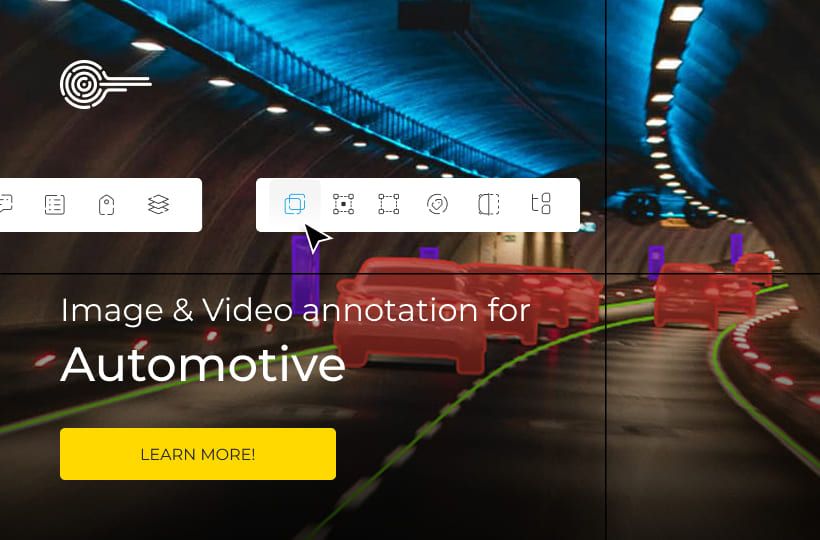
4D Spatio-Temporal Annotation: Object Tracking for Autonomous Vehicles 2026
Modern autonomous driving systems require high accuracy in detecting and tracking objects in complex dynamic environments. Traditional computer vision and sensor processing methods often lack the ability to effectively integrate spatial and temporal information, which is crucial for accurately predicting the behavior of pedestrians, vehicles, and other road users. In this regard, the concept of 4D spatio-temporal annotation is becoming a key research area in the field of autonomous vehicles.
4D annotation combines a three-dimensional spatial representation of objects with a temporal dimension, allowing not only to determine the location of an object in space, but also to track its trajectory in time. This opens up new opportunities for building more reliable tracking systems, motion prediction, and real-time decision-making. In the face of rapidly growing demand for autonomous transportation solutions, improving 4D annotation methods is becoming necessary to improve the safety, efficiency, and adaptability of transportation systems.
Key Takeaways
- High-quality annotations improve safety and decision confidence for every vehicle.
- Sensor fusion (LiDAR + cameras) delivers better depth and visual information.
- AI-assisted labeling reduces time and boosts accuracy when paired with human QA.
- Robust pipelines must meet security and compliance standards at scale.
- The industry needs repeatable workflows to turn raw data into production-ready datasets.

Why 4D spatio-temporal annotation matters now for safer autonomous driving
Modern autonomous vehicles rely on accurate perception and real-time understanding of their environment. Traditional computer vision and sensory processing systems mostly focus on 3D spatial data, i.e., determining the location of objects in space. However, autonomous driving requires knowing not only where an object is, but also how it moves over time.
- Dynamic object detection & temporal tracking. 4D annotation adds a temporal dimension to spatial data, allowing autonomous driving systems to track objects over time. This enables the prediction of trajectories for pedestrians, cyclists, and other vehicles, which is critical for collision avoidance and safe maneuvering.
- Improved scene understanding. The combination of spatial position and its temporal evolution allows autonomous driving systems to distinguish between static objects, temporarily stopped vehicles, and moving objects. This reduces false positives and improves the accuracy of motion prediction.
- Using 4D bounding boxes. 3D bounding boxes, extended in time to 4D bounding boxes, offer a more accurate integration of an object's spatial and temporal characteristics. This allows not only for the accurate localization of the object, but also for modeling its future motion, which is critical for safe trajectory planning.
- Motion prediction & trajectory prediction. 4D spatio-temporal data allows algorithms to predict the future positions of objects based on their past trajectories. This enables proactive decision-making by the car, significantly reducing the risk of accidents in complex and dynamic road conditions.
From 3D to 4D: how autonomous systems understand objects over time
In traditional autonomous systems, the perception of the environment is based on 3D spatial data, enabling the recognition of objects and their positions in three-dimensional space. However, modern road conditions often involve complex scenarios, including fast-moving vehicles, pedestrians, cyclists, and unexpected obstacles. To effectively respond to such situations, spatial coordinates alone are not enough. The transition to 4D spatio-temporal annotation adds a critical time dimension, enabling autonomous systems to understand the behavior of objects in dynamic environments.
Temporal tracking in 4D space enables the continuous tracking of moving objects across long sequences of frames. Thanks to this, the car can register changes in the speed, direction, and position of each object, which significantly increases the accuracy of dynamic object detection in complex urban or intercity conditions. This approach is especially important when interacting with unpredictable road users who can suddenly change their trajectory.
4D bounding boxes enable us to combine the shape, size, position, and temporal evolution of an object. This creates the basis for more accurate modeling of object behavior, since algorithms can analyze not only the instantaneous position, but also the entire history of the object’s motion. This approach opens up new possibilities for trajectory prediction: the system can predict the future trajectories of objects based on their dynamics, even in accelerated or chaotic scenarios.
Motion prediction based on 4D data allows autonomous systems to make proactive decisions. For example, predicting the interaction between vehicles at an intersection or identifying potential collisions with pedestrians becomes possible thanks to the integration of spatial and temporal characteristics.
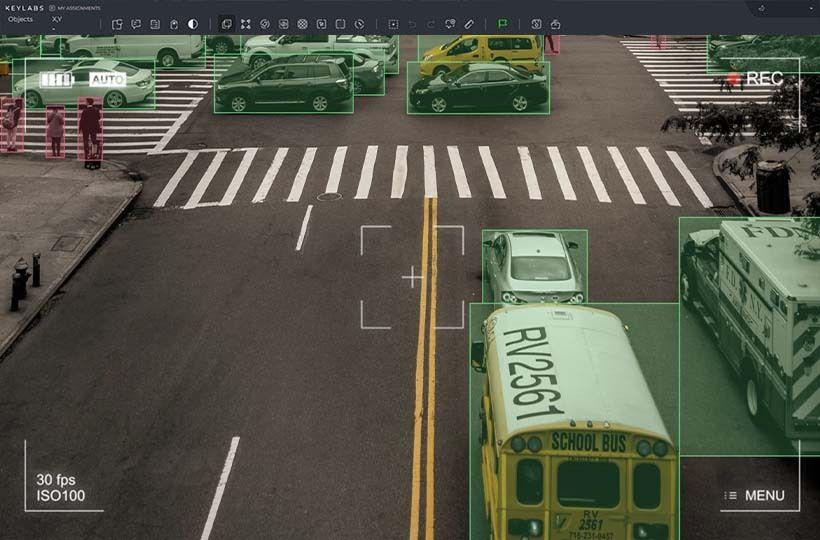
Sensor fusion foundations: LiDAR, cameras, multi-camera setups, and 4D-BEV
Production-grade annotation workflows: speed, quality, and scalability
4D annotation autonomous vehicles: training data that boosts model performance
The quality of the training data has a direct impact on how well an autonomous system understands its surroundings. No matter how powerful a model is, if it is trained on monotonous or incomplete data, its predictions will be inaccurate. That is why modern systems are increasingly using 4D spatio-temporal annotation, which not only tracks the position of objects in space but also their movements in time. This enables algorithms to track the behavior of cars, pedestrians, and cyclists in dynamic conditions, making more accurate motion and trajectory predictions.
Incorporating temporal tracking into datasets enables models to understand how objects change speed and direction, and dynamic object detection allows them to accurately recognize moving objects even in complex scenes. Of particular importance are 4D bounding boxes, which capture the position of an object in space and time simultaneously. This significantly increases the accuracy of predictions and makes the model's behavior more predictable.
Another important aspect is the diversity of data. It is essential that the dataset includes a variety of objects, diverse traffic scenarios, various weather conditions, and different lighting conditions. This allows the model to avoid biases and work reliably even in unusual situations. Using semi-automatic tools for annotation and data validation allows the creation of large, accurate, and consistent datasets that truly “teach” the model to understand the world as a human does.
Summary
Modern autonomous driving systems require not only accurate object detection in space, but also an understanding of their motion over time. The transition from 3D to 4D spatio-temporal annotation opens up a new level of safety and efficiency, allowing systems to track objects over time (temporal tracking), accurately recognize moving objects (dynamic object detection), predict their trajectories (trajectory prediction), and estimate future motion (motion prediction) with high accuracy using 4D bounding boxes.
In the future, the 4D spatio-temporal approach is likely to become the standard for autonomous systems that will not only react to traffic situations but also predict them. The combination of sensor technologies, intelligent annotation, and powerful object motion prediction algorithms will allow autonomous vehicles to integrate more safely and efficiently into urban and intercity environments. This opens up prospects for the development of fully autonomous transport systems capable of making real-time decisions and reducing road risks.
FAQ
What is 4D spatio-temporal annotation, and why is it important for autonomous driving?
4D spatio-temporal annotation integrates spatial information with the temporal dimension, allowing autonomous systems to track object movements over time. It is essential for temporal tracking, dynamic object detection, and accurate motion prediction, improving overall safety and decision-making.
How does temporal tracking enhance the understanding of dynamic objects?
Temporal tracking allows autonomous systems to monitor the trajectory and behavior of moving objects over multiple frames. This capability improves trajectory prediction and supports proactive responses to dynamic scenarios.
Why are 4D bounding boxes critical for motion prediction?
4D bounding boxes capture both the spatial position and temporal evolution of objects, enabling precise motion prediction. They allow models to anticipate future positions and reduce collision risks.
What role does dynamic object detection play in autonomous systems?
Dynamic object detection identifies moving objects, such as vehicles, pedestrians, and cyclists, in real-time. When combined with temporal tracking, it helps models understand motion patterns and predict trajectories accurately.
How does sensor fusion contribute to 4D perception?
Sensor fusion combines data from LiDAR, cameras, multi-camera setups, and 4D-BEV representations. This integration enhances spatial and temporal awareness, supporting the reliable prediction of trajectories and motions.
What are the main challenges in production-grade annotation workflows?
Model-in-the-loop tools pre-label frames, propose track continuations, and interpolate between keyframes. Human labelers validate and correct outputs. This hybrid approach cuts labeling time, maintains high quality, and scales annotation throughput for long LiDAR runs and multi-camera sequences.
How are long sequences and occlusions handled during tracking?
Key challenges include maintaining speed, accuracy, and scalability while annotating large datasets. High-quality 4D bounding boxes and consistent temporal tracking are crucial for ensuring reliable training data for autonomous models.
Why is diverse training data crucial for model performance?
Diverse datasets expose models to a wide range of scenarios, improving generalization. Incorporating dynamic object detection, temporal tracking, and 4D spatio-temporal annotations helps the model learn realistic motion patterns.
How does 4D-BEV improve scene understanding?
4D-BEV projects 3D data into a top-down view over time, simplifying spatial-temporal reasoning. It facilitates trajectory prediction and motion prediction by providing a unified representation of object movement.
What future developments are expected in 4D spatio-temporal perception?
Future systems will increasingly integrate real-time temporal tracking, AI-assisted annotation, and multi-sensor fusion to predict complex behaviors. This will make autonomous vehicles more proactive and safer in dynamic environments.
How do annotation workflows impact trajectory and motion prediction accuracy?
High-quality annotation workflows ensure precise 4D bounding boxes and temporal consistency. This enhances training for trajectory prediction and motion prediction, enabling models to reliably anticipate object movements.