Panoptic Segmentation: Unifying Stuff & Things in Instance Segmentation
Traditionally, segmentation approaches are divided into semantic segmentation, which classifies each pixel of an image, and instance segmentation, which further distinguishes between individual instances of objects. However, neither of these approaches alone provides a complete and consistent description of the scene.
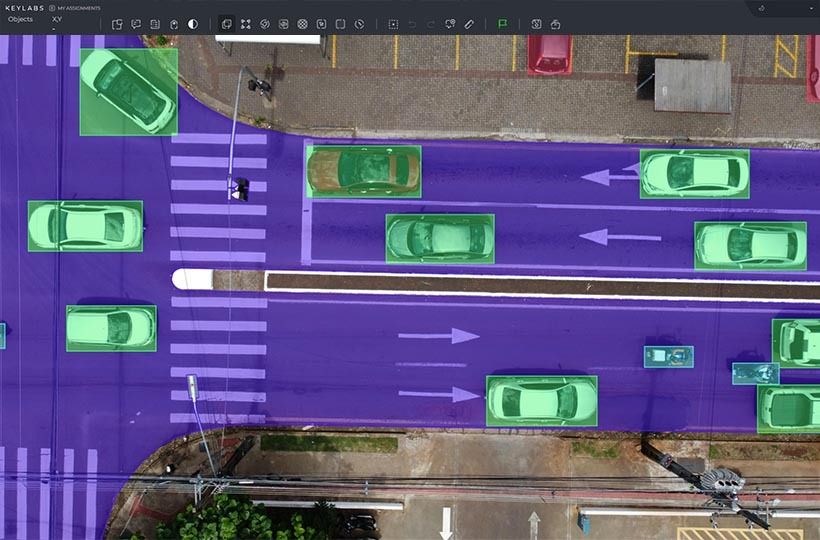
Panoptic segmentation combines the advantages of both approaches. It simultaneously models things — discrete objects with clear boundaries (e.g., people, cars) and stuff — amorphous areas without individual instances (roads, sky, grass). Each image pixel is assigned both a semantic label and, if necessary, an identifier for a specific object, allowing a complete and consistent description of the scene.

The Core Concepts Panoptic Segmentation
Semantic Segmentation vs Instance Segmentation vs Panoptic Segmentation
Things vs Stuff: Defining the Categories That Power Panoptic Results
The categories of things correspond to discrete, countable objects with clearly defined boundaries that can exist as multiple separate instances within a single image. Typical examples are people, vehicles, or animals. For each such object, panoptic segmentation not only defines a semantic class but also assigns a unique instance identifier that distinguishes individual objects of the same class.
In contrast, stuff covers background or amorphous areas of the scene that lack a clear number of instances and are not subject to individual delimitation. Such categories include sky, road, grass, water, or walls. For stuff, only a semantic label is sufficient, since separating instances does not make practical sense.
Thanks to delimitation, each image pixel receives an unambiguous, consistent explanation, which provides a more holistic understanding of the scene and increases the effectiveness of models in complex applied tasks such as autonomous driving, robotics, and urban environment analysis.
Traditional Panoptic Pipeline: FCN + Mask R-CNN Fusion
- Semantic Segmentation with FCN. FCN is used to predict stuff classes and semantic labels for all pixels in an image. The network is trained to predict only the class of each pixel, without distinguishing between individual instances. The output is a class map that provides full image coverage and is useful for background areas.
- Instance Segmentation with Mask R-CNN. Mask R-CNN is responsible for detecting and segmenting things. It generates a bounding box for each object, predicts a pixel mask, and assigns an instance identifier, allowing distinction among multiple instances of the same class.
- Fusion Step. After receiving the results from FCN and Mask R-CNN, they are combined into a single panoptic map. The fusion algorithm determines which pixels belong to things and which to stuff, resolving conflicts and ensuring consistent segmentation without overlaps. The result is that each pixel has a semantic label, and that, for things, each has a unique instance identifier.
Modern Architectures: EfficientPS and End-to-End Panoptic Segmentation
EfficientPS through semantics and instance segmentation in a single network. A single shared backbone generates multi-level features that are fed into two branches: a semantic head for predicting things and pixel classes, and an instance head for segmenting things and assigning instance IDs. The final fusion stage guarantees consistent panoptic output. EfficientPS optimizes computation by using lightweight blocks and efficient feature aggregation, making it suitable for real-time and large-scale applications.
Modern models such as Panoptic FPN, UPSNet, and Mask2Former implement end-to-end learning, where a single network simultaneously predicts semantic labels and instances. This improves the usability of materials and components, eliminates the need for separate fusion stages, and achieves the model's speed and accuracy. For example, Mask2Former uses a unified transform approach, in which a single set of predictors is used for all categories simultaneously.
Key Metrics and Evaluation for Panoptic Segmentation Performance
Common Challenges: Overlap, Occlusion, Data Quality, and Scale
- Overlay. Overlapping objects can lead to conflicts between predicted instances in object detection. It is important to assign instance IDs correctly in the panoptic mask while maintaining accurate stuff segmentation to avoid inconsistencies.
- Occlusion. Partially visible objects complicate thing detection and can lead to incomplete or fragmented panoptic masks. Effective models must be able to recover hidden regions to provide a consistent unified prediction.
- Data quality. Noise, mislabeling, or inconsistent annotations in the training datasets negatively affect both stuff segmentation and thing detection. Poor data quality can lead to errors in the panoptic mask and reduce the reliability of unified prediction.
- Scale. Objects and background regions appear at different scales, making accurate thing detection and stuff segmentation difficult. For accurate panoptic masks at different scene resolutions, it is necessary to use multi-level features and adaptive receptive fields.
Summary
The development of panoptic segmentation allows combining different approaches to scene understanding, integrating work with background areas and individual objects into a single model. Modern architectures aim to eliminate pipeline separation, improve prediction consistency, and reduce computational costs while delivering accurate, unified predictions. The effectiveness of models depends not only on the network structure but also on the quality of the data and the ability to handle overlaps, occlusions, and varying object scales. Evaluation metrics enable a comprehensive analysis of performance, accounting for the accuracy, correctness, and integrity of the resulting panoptic masks. In general, progress in this area opens up opportunities for complex applied tasks where simultaneous work on object segmentation and object detection is important, providing a more holistic and reliable understanding of scenes.
FAQ
What is the main goal of panoptic segmentation?
The goal is to combine object segmentation and object detection into a single, coherent panoptic mask, producing a consistent, unified prediction of the entire scene.
How do modern architectures improve over traditional pipelines?
They unify semantic and instance branches into a single network, reducing conflicts and computational overhead while enhancing the accuracy of unified predictions.
What challenges arise from object overlap?
Overlapping objects complicate thing detection and can cause inconsistencies in the panoptic mask, requiring careful handling to maintain accurate unified predictions.
Why is occlusion a problem for panoptic segmentation?
Partially visible objects make thing detection harder and can fragment the panoptic mask, reducing the reliability of unified predictions.
How does data quality affect performance?
Noisy or inconsistent annotations negatively impact both stuff segmentation and thing detection, leading to errors in the panoptic mask and less accurate unified predictions.
What role does scale variation play in segmentation?
Objects and backgrounds at different scales challenge the network’s ability to maintain precise thing detection and stuff segmentation, affecting the consistency of panoptic masks.
Which metrics are commonly used for evaluation?
Panoptic Quality (PQ), Segmentation Quality (SQ), and Recognition Quality (RQ) measure the accuracy and consistency of stuff segmentation, thing detection, and the overall unified prediction.
How does EfficientPS handle panoptic segmentation?
EfficientPS uses a shared backbone with parallel branches for stuff segmentation and thing detection, producing a consistent panoptic mask in a single forward pass.
What is the advantage of end-to-end models like Mask2Former?
They eliminate separate pipelines by generating unified predictions across all categories simultaneously, improving both efficiency and the coherence of the panoptic mask.
Why is unified prediction important in practical applications?
It ensures that all segmentation and object detection outputs are consistent, which is crucial for autonomous driving, robotics, and any scenario requiring complete scene understanding.