Audit Trails for AI Training Data: What Regulators Will Ask to See
Regulators are now looking not only at how well an algorithm performs, but also at what it is built from.
If your company is developing or adapting AI models, be prepared for a regulatory audit. A clear data lineage and transparent audit trails are the main defenses against fines, forced model unlearning, and reputational damage.
In this article, we'll look at what Evidence regulators will require, how to build a reliable audit log for training data, and what guarantees developer accountability.
Quick Take
- The main issue in an audit is confirming the origin and legality of every byte of data.
- You must trace the entire data path from the primary source (raw content) to the specific batch used to train the model.
- Audit logs should record any manipulations with them: filtering, normalization, and annotation.
- Having a documented audit trail is the company's only legal protection against regulatory demands to forcibly remove model weights.

What is data lineage, and why is it a key element of audits?
Data lineage is a visual and technical representation of the full data lifecycle: from its creation or collection to its transformation, labeling, and final use in training or fine-tuning an AI model.
During a regulatory audit, auditors check whether you can answer three questions about your dataset:
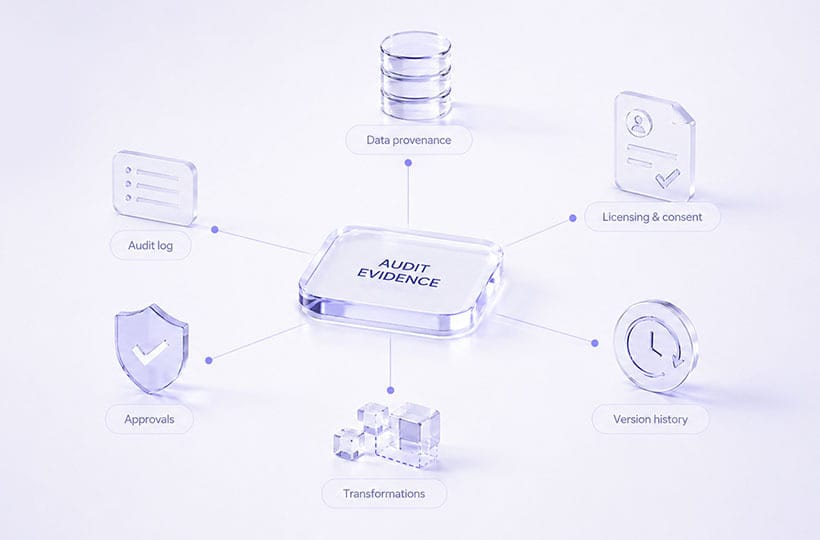
- Where? What is the source of the data? Have the necessary consents, licenses, or confirmation of the absence of prohibitions on parsing been obtained?
- What? What changes have occurred to the data? Who performed the cleaning, removal of outliers, annotation, or synthetic augmentation?
- Where used? In which versions and iterations of the models (v1.0, v1.2-beta) were these specific files used?
If your pipeline has "dark spots" (for example, it is unknown where some of the texts came from or which annotators marked up the 3D cuboids), such a dataset is considered legally unsuitable for use in high-risk commercial AI systems.
Audit log for training data
To ensure full transparency and accountability, AI developers should maintain audit logs.
An audit log is a perfectly encrypted or hashed record of events.
Required fields that regulators will require in your audit logs:
What exactly will regulators require during the audit?
During the regulatory audit, representatives of regulatory authorities are guided by a compliance checklist.
The main blocks of questions that you should be prepared for:
A. Copyright & TDM compliance
Regulators will require a machine-readable log confirming that your AI crawlers checked the robots.txt, ai.txt, and TDM-RP protocols before loading materials. If licensed data from third-party providers was used, you must provide direct license agreements and a chain of custody.
B. Annotation provenance
Requirements are also imposed at the data markup stage. Regulators check:
What instructions (guidelines) were provided to annotators?
What level of agreement between annotators (Inter-Annotator Agreement) was achieved?
Were platforms with audit trails used that allow tracking of every edit in a 3D cuboid or text segment?
C. Model unlearning preparedness
If a data subject or rights holder withdraws their consent, the regulator will ask: "Can you clearly indicate which weights or files in the dataset are associated with this user?" Having a clear data lineage allows for localizing the relevant data and performing a point-by-point deletion procedure without retraining the model from scratch.
How to build a compliance-ready data pipeline?
To achieve full accountability, companies should follow four key steps:
- Fix data provenance standards. Don't store "anonymous" files without accompanying provenance metadata.
- Switch to professional markup tools. Use annotation platforms that automatically maintain a detailed audit log of all annotator actions and QA stages.
- Automate data lineage. Implement specialized data management tools for ML to automatically capture relationships between code, data, and model weights.
- Use clean-room and licensed datasets. If collecting your own data is difficult, engage certified data providers who provide 100% rights-cleared datasets with a full package of audit documents.
The role of Keylabs in creating regulatory-compliant audit trails
When regulators require evidence that the annotation process was transparent, controlled, and ethical, simple markup files cannot provide the necessary level of detail. Keymakr's Keylabs platform is an essential link in building data lineage.
Keylabs is designed to generate audit logs at every stage of dataset preparation automatically.
Keylabs features for regulatory audit:
- Full annotation provenance. The platform captures an exact digital trail for each geometric object or text tag. The annotator ID, time spent on each frame, the version of the guidelines, and the hotkeys/algorithms used. This makes it easy to answer auditors' questions about who created the annotation and how.
- Multi-layer QA workflow. To ensure bias mitigation requirements, Keylabs allows you to configure flexible validation pipelines. The system maintains a separate audit log for QA and supervisor actions, recording all corrections and the percentage of agreement between annotators (Inter-Annotator Agreement).
- Export rich metadata. When uploading a dataset, Keylabs adds cryptographic hashes of the source files, precise timestamps, and annotation session identifiers. This data can be directly integrated into your internal ML pipelines (DVC, MLflow) to provide a reliable data lineage chain from the raw file to the final model weights.
The Keylabs platform ensures that your data annotation stage is fully prepared for validations of any severity, making the annotation process a transparent and legally protected tool.
FAQ
Do I need to keep audit logs if the model is already in production?
Yes, audit logs should be kept throughout the model life cycle and after its completion (5–10 years, depending on the jurisdiction and industry).
What happens if an audit reveals that some data lacks a clear data lineage?
Depending on the severity of the regulator (for example, under the EU AI Act), a company can be fined up to 35 million euros (or up to 7% of global annual turnover), as well as a court order prohibiting the use and forced removal of such an AI model from the market.
How do audit trails help protect against copyright claims?
If a copyright holder accuses your company of illegally using their content, audit trails and data lineage will serve as official proof that the data was obtained from a legal source or filtered out due to a TDM Opt-Out.