Navigating China's AI Data Labeling Rules
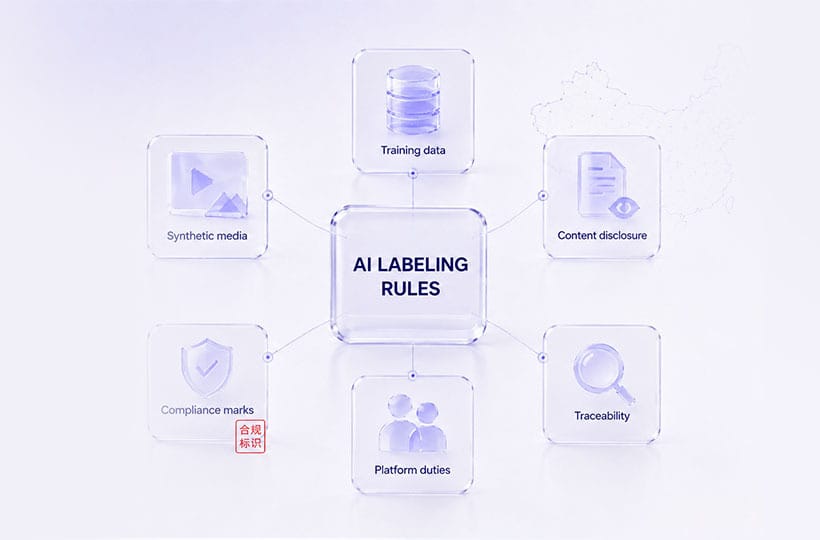
Chinese legislation requires AI developers to strictly label generated content, apply explicit and implicit watermarks, and ensure full traceability of training data. To comply with the Cyberspace Administration of China (CAC) requirements, companies must implement automatic metadata addition, maintain strict data provenance logging, and guarantee the transparency of annotation processes at every stage of dataset preparation.
Quick Take
- All synthetic data requires mandatory AI-generated content labeling via explicit (visual/auditory) and implicit (steganographic) watermarks.
- Annotators are required to separate real physical data from synthetically generated data and record this in the dataset passport.
- Full change history and file provenance are essential prerequisites for passing state audits and registering models in China.
- The compliance process consists of four stages: source recording, segregation with tagging, watermark implementation, and audit log generation.

Key Rules Regulating Data Labeling in China
Artificial intelligence regulation in China is based on two key documents: the Deep Synthesis Provisions and the Interim Generative AI Measures.
Requirements for Marking AI-Generated Content and Compliance Standards
The central requirement of Chinese legislation is mandatory AI-generated content labeling. The regulator prohibits publishing or using synthetic data for further AI model training unless it carries a clear identifier of artificial origin.
For labeling teams and training data providers, this translates into the need to comply with five mandatory rules:
- Mandatory two-tiered marking. Text, images, audio, and video must feature both visible marks for users and invisible digital metadata within the file structure.
- Audit of primary data provenance. Developers and annotators are required to verify the legality of training data sources. Using datasets collected in violation of intellectual property rights or without data subject consent is prohibited.
- Safety value compliance verification. At the labeling stage, content must undergo filtering to ensure the absence of disinformation, incitement to hatred, or materials that threaten China's national security or public order.
- Segregation of real and synthetic datasets. During the preparation of training batches, annotators must clearly distinguish between real physical data and synthetically generated cases, recording this in the dataset passport.
- Modification identification in Deep Synthesis. If a human annotator or algorithm modifies a face, voice, or context in a media file, the system must automatically add a tag specifying the type and extent of the changes made.
How Requirements Impact Data Labeling Processes
Technical Implementation of Explicit and Implicit Watermarks
To comply with CAC requirements, labeling tools must support two types of watermarks:
- Explicit watermarks. Visual or auditory marks that are clearly noticeable to humans. In video and photo datasets, these can be text banners or logos; in generated audio, a low background signal; and in text, special disclaimers.
- Implicit watermarks. Invisible digital marks encoded directly within the data. These can be steganographic changes in the least significant bits of an image, specific frequency modifications in audio, or hidden Unicode characters in text. Such marks remain resilient even after file compression, cropping, or editing.
Why Data Traceability Matters for Regulatory Audits in China
Traceability allows regulatory authorities to instantly trace the complete path of a specific file – from the primary collection source to the algorithm developer and the specific annotator. Without a transparent chain of provenance, an AI system simply will not pass state registration in China.
For companies creating or adapting AI products for the Chinese market, successful regulatory compliance relies on three key pillars:
- Full content transparency. Mandatory implementation of AI-generated content labeling systems allows for clearly separating real and synthetic data right at the annotation stage.
- Technical protection and identification. Using two-tiered watermarking – both visible visual elements and hidden steganographic metadata – protects every file from forgery and disinformation.
- Indisputable end-to-end traceability. Building a logical chain of data provenance guarantees that a regulator or auditor can trace the path of any byte of information from the primary source to the finished training batch.
Building strict quality control, automating logging, and integrating regulatory tags into labeling workflows transform the risks of fines or bans into a clear, manageable, and secure engineering process.
Building a Transparent Data Pipeline for the Chinese Market
Complying with China's regulatory requirements in the AI domain involves a deep technical adaptation of the entire data preparation pipeline. The requirements clearly indicate that the era of chaotic use of undocumented datasets has officially passed.
To ensure full regulatory compliance, companies build a data pipeline through four mandatory stages:
1. Primary Source Recording.
Registering the origin of raw data, verifying licenses, subject consent, and the absence of personal information prior to any file manipulations.
2. Annotation and Segregation.
Content classification by human annotators or automated systems with mandatory assignment of AI-generated content labeling tags for synthetic fragments.
3. Watermark Implementation.
Automatic generation and embedding of hidden cryptographic metadata into the file structure using annotation tools.
4. Dataset Passport Generation.
Generate an immutable action log and documentarily confirm the readiness of the training batch for delivery to the regulator or client.
FAQ
Do CAC rules regarding data labeling apply to foreign companies?
Yes, if a foreign company deploys AI models for users in China or uses Chinese datasets to train its services. Even if the annotators themselves operate outside of China, the final training batches and generated content must comply with CAC requirements regarding marking and traceability.
What happens to watermarks during data post-processing or compression?
According to the requirements, implicit watermarks must possess a high level of resilience. Companies are required to use steganographic algorithms that preserve cryptographic metadata even after cropping, resolution changes, codec compression, or audio sampling rate changes.
Is it necessary to apply AI-generated content labeling to partially generated data?
Yes, under Chinese law, Deep Synthesis technologies or combined editing are subject to mandatory tagging. Labeling instructions must clearly specify the type of modifications made and the percentage of synthetic content in the file.
What liability is envisioned for a lack of training dataset traceability?
The absence of a documented data provenance chain makes state registration of the AI model with the CAC impossible. The regulator holds the authority to block the service, issue administrative fines, or prohibit the use of the corresponding dataset for commercial AI training.