Applying the NIST AI Risk Management Framework to Training Data
As AI systems become more autonomous and complex, the demands on their reliability, security, transparency, and fairness increase. One of the key factors determining the quality of AI models is the training data they are trained on. Deficiencies in the composition, quality, or representativeness of such data can lead to model bias, erroneous decisions, privacy breaches, and other negative consequences.
To systematically manage the risks associated with the development and use of AI systems, the US National Institute of Standards and Technology (NIST) has developed the AI Risk Management Framework (AI RMF). This concept offers a comprehensive approach to identifying, assessing, mitigating, and continuously monitoring risks at all stages of the AI system lifecycle.

Theoretical foundations of risk management in AI systems
Along with the benefits of using AI, there are risks that can negatively affect the efficiency of systems and impact individual users, organizations, and society as a whole. That is why risk management is an integral part of the development, implementation, and operation of modern artificial intelligence systems.
In general, risk is the possibility of undesirable consequences arising from uncertainty or the influence of specific factors. In the context of artificial intelligence, risk is associated with the probability that the system will malfunction, make biased decisions, violate human rights, or pose threats to information security and data confidentiality.
A feature of risks in AI systems is that they can arise at any stage of the model life cycle: during data collection and preparation, algorithm training, testing, implementation, operation, or subsequent system updates. At the same time, a significant part of the potential problems originates precisely from the training data, which determines the quality of training of machine learning models.
The main categories of risks associated with artificial intelligence systems include:
- risks of low data quality, which lead to reduced model accuracy.
- risks of bias, which can lead to discriminatory outcomes for certain user groups.
- risks of confidentiality breaches and personal data leakage.
- cybersecurity risks arising from potential attacks on models or training datasets.
- risks of insufficient transparency and explainability of models.
- risks of non-compliance with regulatory and ethical requirements.
Effective management of these risks involves their timely identification, assessment, documentation, minimization, and constant monitoring. This approach allows you to increase trust in artificial intelligence systems, ensure their safe operation, and minimize potential negative consequences for users.
Lifecycle of AI Systems
The life cycle of an artificial intelligence system encompasses a set of interconnected stages from problem definition to system decommissioning. Each of these stages presents specific risks that require appropriate management.
The main stages of the life cycle are:
- Requirements generation – defining the goals, scope, stakeholders, and performance criteria of the system.
- Data collection and preparation – obtaining, cleaning, annotating, integrating, and checking the quality of training data.
- Model development and training – selecting algorithms, training models, and tuning their parameters.
- Testing and validation – assessing the accuracy, robustness, fairness, and security of the model.
- System deployment – integrating the model into the operating environment.
- Monitoring and maintenance – monitoring performance, detecting data and model drift, updating training data, and retraining models as needed.
The most critical stage is preparing training data, as data quality determines the model's ability to generalize and make correct decisions. Errors made during data collection or processing can be inherited by the model and manifest themselves throughout its life cycle.
The role of training data in the functioning of AI systems
Training data is the basis of any machine learning system. It is they who contain the information on which the algorithm detects patterns, builds mathematical models,, and develops the ability to perform the set tasks.
The quality of training data is determined by the following characteristics:
- completeness.
- reliability.
- relevance.
- representativeness.
- balance.
- absence of critical errors and duplication.
- relevance to the task set.
If the training set contains distortions or does not sufficiently represent certain object categories, the model may exhibit biased results and low prediction accuracy. In addition, the use of data of unknown origin or the violation of confidentiality requirements can create legal, ethical, and reputational risks.
NIST AI RMF Core Principles
The framework is based on the concept of Trustworthy AI, which requires that systems not only demonstrate high accuracy but also meet the requirements of security, fairness, transparency, and accountability.
The main characteristics of trustworthy AI systems are:
- Valid and Reliable - the system consistently performs its tasks and provides predictable results.
- Safe - the system does not pose unacceptable risks to users and society.
- Secure and Resilient - the system can withstand cyberattacks, manipulation, and technical failures.
- Accountable and Transparent - decisions related to the creation and use of AI can be explained and verified.
- Explainable and Interpretable: users must understand the system's logic and the factors that influence its decisions.
- Privacy-Enhanced - personal data must be processed in accordance with legal requirements and modern information security principles.
- Fair - the system must minimize discrimination and unjustified bias against specific user groups.
Applying the NIST AI Risk Management Framework to Training Data
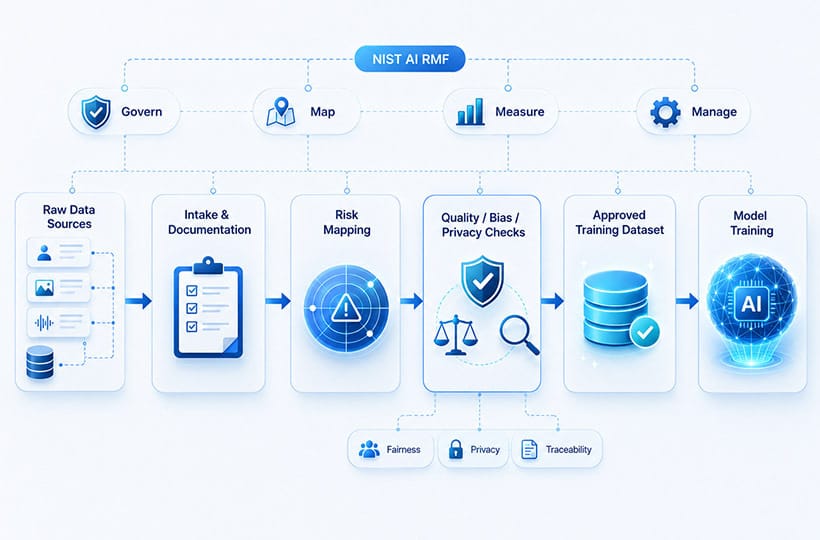
The practical application of the NIST AI Risk Management Framework (AI RMF) to training data involves integrating the four core functions - Govern, Map, Measure, and Manage - throughout the entire data lifecycle. This approach enables organizations to identify, assess, mitigate, and continuously monitor risks associated with data quality, bias, privacy, and security.
The Governance function establishes organizational policies and accountability for data management; Map identifies potential risks and contextual factors affecting training data; Measure evaluates the quality and impact of these risks using appropriate metrics; and Manage focuses on implementing mitigation strategies and continuous improvement. Applying these functions throughout the training data lifecycle enhances data quality, reduces bias, improves regulatory compliance, and increases the reliability, fairness, and trustworthiness of AI systems.
FAQ
What is the NIST AI Risk Management Framework (AI RMF)?
The NIST AI RMF is a voluntary framework designed to help organizations identify, assess, and manage AI-related risks. It promotes the development of trustworthy and responsible AI systems.
Why is risk management important in AI?
Risk management helps reduce the likelihood of failures, bias, privacy violations, and security threats. It ensures that AI systems operate safely and reliably throughout their lifecycle.
What is trustworthy AI?
Trustworthy AI refers to AI systems that are reliable, fair, secure, transparent, and accountable. These characteristics help build confidence among users and stakeholders.
Why is training data important for AI systems?
Training data determine how an AI model learns and makes predictions. Poor-quality or biased data can significantly reduce model performance and fairness.
What are the main data risks in AI?
Common data risks include poor data quality, bias, lack of representativeness, privacy breaches, and data drift. These risks can lead to inaccurate or unfair AI outcomes.
What are the four core functions of the AI RMF?
The framework consists of four functions: Govern, Map, Measure, and Manage. Together, they provide a continuous process for AI risk management.
How does the Govern function support training data management?
Govern establishes policies, responsibilities, and documentation practices for handling data. It ensures proper data governance and regulatory compliance.
How does the Measure function reduce data risk?
Measure evaluates data quality, fairness, accuracy, and security using appropriate metrics and testing methods. It helps identify weaknesses before deploying AI models.
What is data drift, and why is it a risk?
Data drift occurs when new data differ from the data used to train the model. This can decrease model accuracy and require retraining or dataset updates.
How does AI RMF improve trustworthy AI?
AI RMF integrates risk management into every stage of the AI lifecycle. Addressing technical, ethical, and organizational risks, it helps organizations build more trustworthy AI systems.