Dataset Annotation for Robotics: Methods and Tools
Data annotation for robotics differs fundamentally from classic computer vision, where the primary goal is object recognition and classification. In robotics, the focus shifts from passive recognition to labeling action capabilities. In other words, if in standard tasks it is sufficient to bound an object with a frame, then for a robot this is ineffective: it requires precise key points that define the geometry of contact, because the success of manipulation depends on millimeter precision at the point of touch.
The technical complexity of annotation for robots also lies in the necessity to work with three-dimensional data and high temporal stability. Labels must exist both on the 2D plane of the image and in 3D space, using point clouds or depth maps, so that the agent can calculate the distance to the object. Besides this, temporal consistency is important – the label must "stick" to the object throughout the entire motion of the video sequence, as any jitter or displacement of the annotation leads to unpredictable behavior of the manipulator and the risk of the system failing.
Quick Take
- Unlike classic AI, where an error of a few pixels is not critical, in robotics, it leads to a physical collision or the dropping of an object.
- Labels must be stable not only in 3D space but also in time to avoid the "jittering" of control algorithms.
- Simulators allow obtaining ideal labeling, overcoming the deficit of real data.
- Proprioceptive labeling gives the robot an understanding of its own physical limits, which is an analog of the human vestibular system.

Basic Categories of Annotation in Robotics
Unlike standard artificial intelligence, a robot must perceive the world as a space for actions. For this, developers use various AI training datasets for robotics, which teach the machine to see, feel volume, plan movements, and even understand its own physical capabilities. Each type of data requires its own approach to labeling in order to transform "raw" sensor signals into understandable instructions.
Vision
Visual data is the foundation for most modern systems. Image labeling robotics includes determining what is in front of the camera and exactly where the boundaries of objects pass. This allows the robot to precisely understand the shape and contours of an obstacle for safe movement.
Three main labeling methods are used for this:
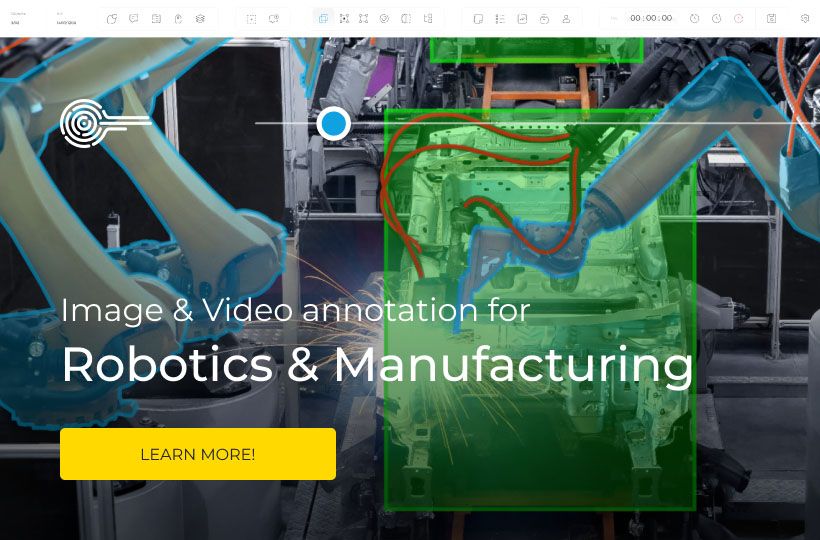
- Bounding boxes – simple highlighting of objects with rectangles, which helps to quickly find targets.
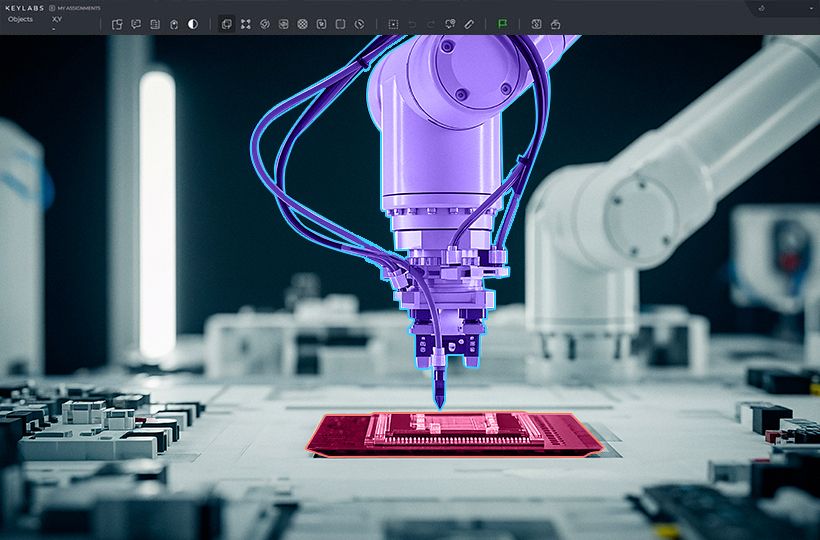
- Segmentation – pixel-by-pixel coloring of an object so the robot sees its exact boundaries.
- Keypoints – marking critical points (corners, handles, bends) that serve as landmarks for subsequent actions.
Without high-quality visual labeling, a robot will remain "blind" to details. For example, when sorting waste, the system must know that it is facing a bottle and see its neck and bottom to grasp it correctly. Thus, detailed segmentation and the placement of key points transform a regular photo into a map for manipulation.
3D Data
Since robots live in a three-dimensional world, a flat picture is insufficient for them. They use laser scanners and special cameras to build point clouds. Annotating such data is much more complex, as specialists have to work in 3D space, rotating the object model from all sides to correctly fit it into a volumetric frame.
This data allows the robot to understand depth and distance with millimeter accuracy. If a camera can make a mistake due to poor lighting, a point cloud gives clear geometric information about the object's structure. This allows automated systems to confidently maneuver in narrow corridors or work on complex production lines where it is important not to hit equipment.
3D data labeling also includes surface classification. For example, a robot must distinguish the floor, which can be driven on, from a wall or a glass partition. Such high detail makes autonomous systems reliable in real conditions, where an error in determining distance can lead to an accident.
Motion
The motion annotation section focuses on trajectories and poses. Developers mark the ideal paths along which the robot's arm or its wheeled base must move to perform the task as efficiently and smoothly as possible.
Pose labeling includes recording the position of each robot joint at every moment in time. This creates a base for learning through imitation: the robot sees how a human performs an action and tries to repeat the same rotation angles and speeds. Such work requires high precision, as an incorrectly labeled trajectory will make the machine's movements sharp or dangerous for people nearby.
Furthermore, motion annotation helps the robot predict future states. By learning from thousands of examples of correct movements, the system begins to understand the physics of the process: how inertia influences stopping or how the center of gravity shifts when lifting a load. This makes the robot's behavior more predictable and professional.
Interaction
This section is dedicated to the precise moments of contact between the robot and objects. Here, annotators mark grasp points, suggesting to the AI exactly where it is best to hold an object so it does not slip. This is the most complex stage, as the grasp point for a hammer will be completely different from that for a glass goblet.
Contact states also include a description of what happens after touching. Does the object slide? Is it securely fixed? Annotating these moments allows the robot to learn from mistakes and adjust its force in real time. This is necessary for service robots that must work with fragile household items.
Internal State
Finally, the robot must understand itself. For this, proprioceptive data labeling robotics is used – the labeling of data from internal sensors. This is information about the force with which motors press on joints, the current being consumed, and the position of limbs relative to the robot's body.
This data is often combined with force indicators and tactile sensations. Annotating such parameters helps the system understand the limits of its capabilities: for example, the maximum weight it can lift without tipping over. This internal "sense of body" allows the robot to act confidently, even if external cameras are temporarily covered or do not provide a complete picture.
Working with internal states also helps in diagnostics. Labeled data regarding the normal operation of motors allows the AI to notice anomalies in time, even before a breakdown occurs. Thus, annotation transforms a pile of sensors into a coordinated, biologically similar system that knows its own strengths and takes care of its own safety.
Annotation Methods
The process of data labeling for robotics is constantly evolving, attempting to overcome the main barrier – the high cost and complexity of preparing high-quality datasets. Because a robot needs extraordinary precision, developers use a whole arsenal of approaches: from careful verification of each frame by a human to the creation of fully autonomous systems where data is labeled by sensors or simulators themselves.
Manual Annotation
Manual labeling remains the most reliable method for creating a "gold standard" of data. At this stage, specialists use annotation tools AI to manually outline object contours, place key points on manipulator joints, or highlight safe zone boundaries in 3D point clouds. This is painstaking work where each pixel matters, as the robot will learn basic skills from these examples.
Although the manual method is the slowest, it is indispensable for complex scenarios where automation often fails: for example, when recognizing heavily occluded objects or defining specific grasp points for new tools. Today, tools for manual labeling are becoming increasingly convenient, allowing annotators to work with video streams and volumetric data in a unified interface, which improves the quality of the final result.
AI-Assisted
To accelerate the process, modern tools integrate auxiliary neural networks. This method works on the principle of "pre-labeling": the AI independently analyzes an image or video and suggests its annotation variants (for example, automatically highlighting a box's contours), while the human only checks and corrects errors. This allows for reducing the time spent on each frame several times over while maintaining high precision.
This approach works especially effectively in video annotation. When an annotator marks an object on the first frame, tracking algorithms automatically "drag" this label through subsequent frames. If the robot moves and the angle changes, the specialist intervenes only when the algorithm loses the object, which makes the image labeling process for robotics significantly more scalable.
Simulation-Based
The most innovative method is the use of simulation environments. In a virtual world, we have complete control over every object, so the system knows the exact coordinates, names, and properties of each pixel on the screen. This allows for the generation of automatic "ground truth labels" without involving a human.
In a simulation, one can instantly create thousands of variations of a single scene: change lighting, the color of objects, or camera position. The robot receives ideally labeled data for learning navigation or manipulation, which allows for the accumulation of experience across millions of scenarios that are physically impossible to replicate in a real laboratory. This is the main tool for overcoming the data deficit in modern robotics.
Sensor-Driven
This method uses the very physics of interaction to create labels. For example, if a robot tries to grasp an object and the force sensors on its "fingers" record a successful hold, the system automatically marks this grasp point as "successful". Such automatic labels from sensors allow the robot to learn directly during the operation process, transforming real experience into learning material.
Combining visual data with proprioceptive data labeling for robotics creates unique datasets. The system automatically links the picture from the camera with the indicators of motor load and tactile sensations. This allows for the annotation of data "from the first-person perspective", where the robot itself becomes a source of knowledge about the world, recording moments of collisions, sliding, or successful task execution without outside help.
Tools for Data Annotation
The choice of the right software is a stage on which the convenience of engineers operating data depends. Modern tools have turned into complex ecosystems capable of automating routine tasks and integrating into complex development cycles of embodied intelligence.
- General tools. These are basic for any team working with visual data. Open-source platforms, flexible web interfaces, and lightweight labeling programs allow for quick labeling of images and videos.
- 3D annotation tools. When a robot needs an understanding of volume, standard 2D tools become helpless. Specialized solutions support 3D point cloud annotation, data visualization, and 3D editor plugins for manual object isolation.
- Robotics-specific tools. These are tools of the future where annotation happens not by hand, but through programming the environment's behavior. Professional simulators, game engine extensions, and physical simulators for interaction allow for the generation of vast volumes of ideally labeled data in virtual worlds.
- Enterprise platforms. When a project reaches an industrial scale, platforms are needed that accompany data from the moment of collection from sensors to the final model training. Comprehensive service platforms with automated workflows and integrated data management systems minimize the time from "raw" recordings to a functioning algorithm.
FAQ
How is the "sim-to-real gap" problem solved when using synthetic data?
To overcome the difference between ideal simulation and the chaotic real world, the domain randomization method is used. Annotators and engineers in the simulation intentionally change textures, lighting, and introduce noise into sensor data so that the model does not get used to ideal conditions. This forces the neural network to focus on object geometry rather than its visual representation, which facilitates the transfer of skills to real hardware.
Are there privacy standards when annotating data from delivery robots or home assistants?
Yes, because robots collect data in public or private spaces. Before the annotation stage, all human faces, car license plates, and gadget screens must be automatically blurred. Professional annotation platforms implement strict access protocols so that human annotators cannot copy or distribute confidential footage from private homes.
How to annotate data for tasks where the robot must interact with deformable objects?
This is one of the most complex tasks where standard Bounding Boxes do not work. For such objects, dense segmentation or meshes that describe surface topology are used. Annotators must mark not only boundaries but also physical properties, such as tension vectors or probable zones of deformation, so the robot understands how the object's shape will change after a touch.
How does the delay in processing annotated data affect the robot's safety in real time?
Annotation quality directly affects the complexity of the model that will subsequently run "onboard" the robot. If the annotation was too detailed but redundant, the model might become too slow for edge devices. Engineers seek a balance, labeling only those features that are critical for decision-making in milliseconds to avoid accidents due to computational delay.
How to annotate data for the group interaction of several robots?
In such projects, annotation includes not only individual actions but also communication vectors and mutual positioning. It is necessary to label a "joint map" where each agent sees itself and its partners in a unified coordinate system. This requires complex synchronization of timestamps from many cameras simultaneously so that the robots' actions are coordinated.
What is the role of annotation in training robots through reinforcement learning?
In RL, annotation often shifts toward the creation of "reward functions". A human annotator can evaluate the robot's attempts to perform an action on a scale from "successful" to "dangerous". These evaluations become labels based on which the AI understands which movement strategies lead to a result and which lead to a breakdown.
How do weather and lighting change the approach to LiDAR data annotation?
In rain or fog, LiDAR generates many false points that reflect off water droplets. Annotators must learn to distinguish real obstacles from atmospheric interference, which requires special training. Sometimes, separate label classes like "noise" or "atmospheric phenomenon" are created to teach the robot to ignore them during navigation.
Are there "self-annotated" datasets where a robot learns without human intervention at all?
This is the direction of self-supervised learning, where the robot uses a temporal sequence of frames as a teacher. For example, it sees an object now and predicts where it will be in a second. If the prediction matches reality, the system itself confirms the "label". Although this does not replace manual labeling entirely, it allows models to learn from huge volumes of unlabeled video from YouTube or street cameras.