Synthetic Data for Robotics: Benefits and Use Cases
Unlike digital systems, where data can be generated almost continuously, robotics faces the barrier of the physical world. Collecting high-quality real-world data for robot training is an expensive and slow process, as it requires the physical presence of equipment, operators, and specially equipped testing grounds. Every hour of training in reality translates to personnel costs and gradual wear and tear on expensive hardware, making large-scale experiments economically risky.
Additional complexity is created by the impossibility of safely practicing rare scenarios. Training a robot to act in dangerous situations within a real environment carries the threat of injury and property destruction. As a result, developers often receive datasets consisting mostly of correct conditions, whereas creating reliable intelligence requires millions of diverse and often stressful situations that the physical world simply cannot provide in the necessary quantity and pace.
Quick Take
- Synthetic data allows for bypassing real-world limitations, where data collection is slow, expensive, and risky for equipment.
- Training covers vision, depth, movement dynamics, and complex physical interaction.
- The use of precise virtual copies of real factories or warehouses allows for tuning a robot even before it arrives at the location.
- Businesses gain the ability to test dangerous scenarios without risk to life and to bring products to market significantly faster.

Types of Synthetic Robotics Data
Synthetic data is artificially created information that allows robots to learn in a virtual environment before they encounter the real world. Thanks to AI training simulation, developers can create millions of scenarios, allowing a robot to "live" through thousands of hours of virtual experience in mere minutes while receiving perfect labeling for every frame.
Vision Data
Visual data serves as the robot's "eyes", so extremely detailed images are created in simulation where every pixel has its own label. Using simulated data AI, a model can be trained to recognize objects even in difficult conditions: in bright sun, in darkness, or in fog.
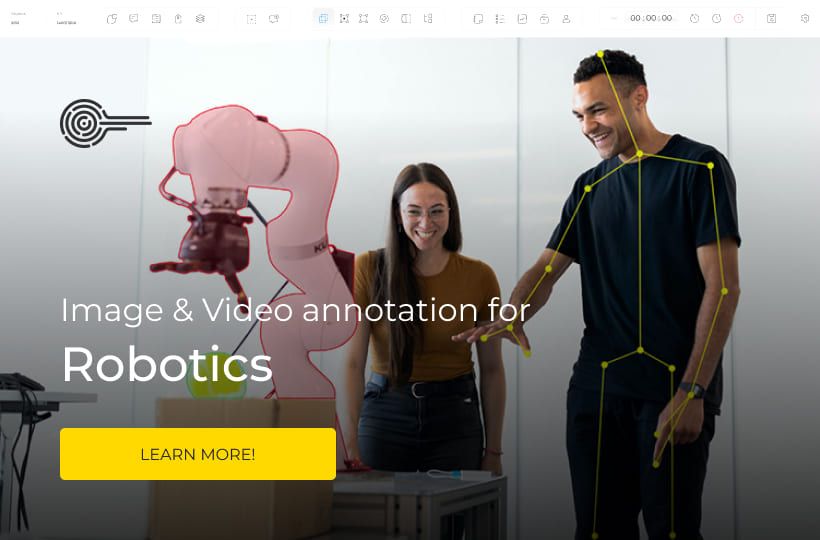
Segmentation is of particular importance – a process where every object in a video is colored with a distinct color. This allows the robot to clearly see the boundaries of items located nearby. In real life, such manual labeling takes hours, whereas in a virtual environment, it is generated automatically and with absolute precision.
Furthermore, visual synthetics allow for changing the appearance of items: adding scratches, changing textures, or colors. This prepares the robot's intelligence for the fact that objects in reality may look different, and it will not be confused by new visual details it did not encounter during training.
3D Data
In order for robots to understand the depth and volume of space, depth maps are used, which show the distance to every object. In simulation, the distance to every point is always precisely known, allowing for the creation of ideal training sets for sensors responsible for navigation and collision avoidance.
An important component is point clouds – sets of millions of coordinates in space, usually obtained using LiDAR. The use of digital twin robotics allows for creating an exact 3D copy of a room where a robot can practice recognizing complex geometric shapes.
Thanks to this data, the robot learns to build an internal map of the environment. This allows it to navigate effectively in cluttered rooms, correctly calculate passage heights, and avoid situations where it might get stuck or clip equipment.
Motion Data
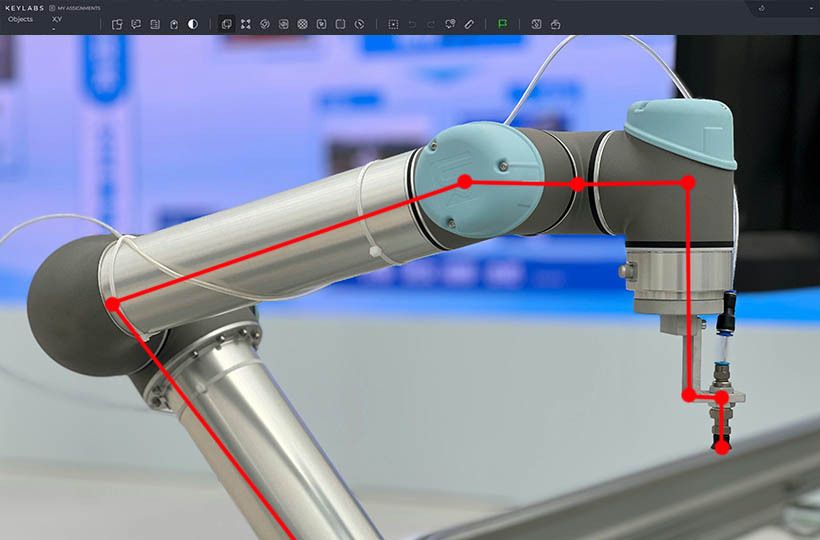
For a robot to move smoothly and safely, it needs to learn millions of route variations. Movement data includes trajectories – lines along which manipulators move. In simulation, the most complex maneuvers can be tested without the risk of tipping the robot or breaking its mechanisms, which would be inevitable when testing on real hardware.
The types of movement data and their purposes can be summarized in the following table:
Training on such data allows robots to predict the physics of their own bodies. For example, a mobile robot learns to brake in advance, taking into account the weight of its cargo, so as not to overshoot the desired point due to inertia.
Interaction Data
This is the most complex level of training, where the robot learns to touch the world. Interaction includes object grasping – for example, how firmly a manipulator needs to be squeezed to lift a fragile glass bottle without breaking it, or a heavy metal part, so that it does not slip out. Manipulating objects requires practicing millions of attempts.
In a virtual environment, a robot can drop a part a thousand times until it finds the correct grip angle. Additionally, simulation allows for modeling collisions. The robot learns to understand which touches are part of the task and which are emergency situations that should be avoided.
Such data allows for the creation of reliable controllers for assistant robots. Thanks to synthetics, a machine learns to work in a chaotic environment where objects may be slippery, soft, or unbalanced in weight.
How Synthetic Data is Generated
The process of creating data for robotics is a combination of high engineering and digital art. Instead of simply copying reality, developers build complex mathematical models where every movement and every ray of light obeys strict laws of physics.
Simulation Engines
The foundation of the entire process is specialized game and physics engines. They create a virtual space where gravity, friction forces, and inertia operate. In such physics-based worlds, a robot is a set of connected parts, each with its own weight, center of mass, and movement constraints.
When a robot in simulation touches a virtual table, the engine calculates the impact force and surface reaction in real time. This allows developers to test complex control algorithms without fear of breaking a real manipulator. The robot learns to "feel" environmental resistance and adapt to it, which is critical for safe operation near humans.
Digital Twins
A digital twin is an ideal virtual copy of a real system: a specific factory, warehouse, or even an individual robot. Instead of creating abstract levels, engineers transfer exact room dimensions, shelving layouts, and lighting characteristics of a real object into the simulation. Thus, the robot "gets used" to its work area before it is even taken out of the box.
Thanks to digital twins, one can find logistics bottlenecks or potentially dangerous zones where a robot might get stuck in advance. The model is constantly synchronized with reality, allowing for virtual testing of any process changes without stopping actual production.
Procedural Generation
In order for AI to be flexible, it needs to see thousands of different rooms. Procedural generation allows for the automatic creation of an infinite number of unique scenes based on a set of rules. Instead of manually drawing every room, the algorithm itself arranges walls, windows, furniture, and random objects, creating a new maze for robot training every time.
This approach guarantees that the model will learn general navigation principles. In such scenarios, the system can automatically generate:
- Different types of floor coverings (slippery tile, carpet, and concrete).
- Random obstacles in the path (forgotten boxes, trash, open doors).
- Various configurations of shelving and workbenches.
Domain Randomization
The biggest challenge is ensuring that the robot does not get "confused" in reality after simulation. Domain randomization is a technique where the simulation is intentionally made "stranger" than reality. We change object colors to unnatural ones, add extreme lighting, swap textures for random patterns, and simulate various weather conditions: from heavy rain to blinding sun.
This forces the neural network to ignore unimportant details and focus on the essence of the task – for example, the shape of the object to be picked up. When, after such "chaotic" training, the robot sees a real part in an ordinary workshop, it seems much simpler and clearer to it, allowing for the successful bridging of the gap between virtuality and reality.
Where it Already Works
Synthetic data is a powerful working tool for the world's largest technology companies today. It allows for training machines in actions that were previously considered too complex for algorithms.
Autonomous Mobile Robots
Thousands of autonomous mobile robots operate in modern warehouses and large distribution centers. The main task of such a machine is to safely move between shelves, avoiding collisions with people and other equipment. Thanks to synthetic data, developers can model an infinite number of warehouse situations: from cluttered aisles to the sudden appearance of a forklift from around a corner.
Synthetics allow robots to perfectly practice route planning in conditions that are difficult to reproduce in reality. For example, one can model a slippery floor due to spilled liquid or a situation where sensors are blinded by bright sunlight from open warehouse gates. Training in simulation ensures the robot will know how to act before it ever heads out onto a real site.
Beyond safety, the use of AI training simulation allows for optimizing the operational speed of the entire fleet of machines. Simulation helps algorithms find the most efficient movement trajectories, which minimize warehouse traffic jams and reduce cargo delivery time from point to point. This makes logistics faster, cheaper, and significantly more reliable.
Home Robotics
The home environment is one of the most difficult for AI due to its unpredictability. Smart vacuums and assistant robots face chaotic interiors where wires, children's toys, or pets may lie on the floor. Using digital twins robotics allows for the creation of thousands of virtual apartments with different layouts and furniture types to train home assistants.
Thanks to synthetic data, robots learn to distinguish objects that should not be touched. For example, simulation helps train a vacuum to recognize whether it is the edge of a carpet that can be crossed or spilled pet food that needs to be cleaned up. This significantly increases the autonomy level of devices, reducing cases where a robot gets "stuck" and requires human assistance.
Synthetics also allow for testing robot interaction with humans in home conditions. Modeling the movement of people in a room teaches the robot to predict their movement trajectory and stop or give way in time. This creates a sense of safety and comfort when using AI in personal space.
Agrotechnology and Autonomous Farms
In agriculture, synthetic data helps create robots for harvesting and plant care. The main difficulty here is the diversity of nature: fruits can be at different stages of ripeness, hidden behind leaves, or wet with dew. In simulation, developers create digital models of fields where various crop growth stages and any weather conditions – from a foggy morning to twilight – can be simulated.
Synthetic models can detect specific spots on leaves or changes in stem color, allowing scanner-robots to identify a problem with higher precision. Thanks to this, farmers can use fertilizers or treatments in a targeted manner, significantly saving resources and reducing environmental impact.
Also, synthetic data is indispensable for training autonomous tractors and combines. Modeling uneven terrain, different soil densities, and obstacles like large stones or trees helps machinery work in the field without a driver. This increases agribusiness efficiency, allowing field work to be conducted around the clock, regardless of personnel availability or visibility.
Business and Safety Benefits
Implementing synthetic data in robotics is both a technical solution and a strategic step that fundamentally changes the economics of development. Using virtual environments allows companies to bypass physical limitations, significantly reduce risks, and achieve results that were previously unavailable due to the human factor.
Safety First
One of the greatest advantages of simulation is the ability to test the most dangerous scenarios with impunity. In the real world, testing the emergency braking of a heavy forklift in front of a person or a drone maneuvering in a thick forest threatens the lives of personnel. In a virtual environment, however, developers can reproduce emergency situations millions of times until the algorithm learns to react to them perfectly.
This approach allows for creating "stress tests" for AI that are impossible or too expensive to implement in reality. For example, one can model the failure of one of a robot's motors or a sudden loss of connection with sensors. Training in such extreme conditions ensures that in a real critical situation, the machine will execute a pre-rehearsed safety protocol, protecting people and property.
Beyond physical safety, simulation provides legal certainty for businesses. Companies can provide digital evidence that their system has passed thousands of hours of testing in complex scenarios before entering the market. This becomes an important argument during product certification and liability insurance, as it confirms the reliability of intelligent control systems.
Speed to Market
The traditional robot development cycle involves a long stage of creating a physical prototype, after which software writing begins. Synthetic data allows for breaking this chain: software developers can start training algorithms on digital models while the real robot exists only in the form of blueprints. This parallel design shortens development timelines by months or even years.
The ability to iterate on a product in virtuality allows companies to quickly change a robot's design or characteristics, seeing instant results in the simulation. Acceleration also applies to the scaling process. When a company decides to open a new warehouse with a different layout, it does not need to transport physical robots there for training. Thanks to virtual copies of the premises, algorithms can be adapted to the new location in advance. When the real hardware arrives on-site, it will already "know" how to work in that environment, allowing operations to start almost instantly.
Perfect Data Labeling
Since the computer itself creates the scene, it knows the exact coordinates of every object, its speed, mass, and even which part of the item is hidden behind an obstacle. This gives developers precise labeling without any human intervention. The robot receives a perfect mathematical description of what it sees. This eliminates noise and inaccuracies in training sets, which is vital for high-precision tasks like microsurgery or assembling complex electronics.
Such labeling automation radically reduces the cost of data preparation. Instead of maintaining thousands of annotation specialists, a company invests in a single simulation engineer who can generate millions of perfectly labeled frames per day. This makes the model training process infinitely scalable: you can double the amount of data simply by adding computing power, which is a decisive advantage in the era of large models and physical AI.
FAQ
Which physical phenomena are the hardest to model for synthetic data?
The greatest difficulty is caused by soft bodies, fluids, and the friction of small particles, as their behavior requires enormous computing power. It is also hard to perfectly convey tactile sensations and micro-changes of a surface when manipulating very fragile items.
Is it expensive for a company to develop its own simulator?
Creating a professional simulator from scratch is a multi-million dollar investment, so most companies use ready-made platforms. A business's main expenses usually go toward the salaries of engineers who create specific scenarios and digital copies of objects.
How does synthetic data help in training surgical robots?
In medicine, synthetics allow for modeling various anatomical pathologies and rare complications that cannot be practiced on live patients or mannequins. This provides "perfect labeling" of tissues and vessels, helping the assistant-robot identify risk zones with pixel-level precision.
Is it safe to use synthetic data for military or rescue robots?
It is not only safe but necessary, as modeling disaster zones or combat actions in reality is too dangerous or impossible. Simulation allows a robot to practice thousands of hours of navigation in collapsed buildings or at extreme temperatures without the risk of losing an expensive apparatus.
How does procedural generation help combat AI bias?
Humans tend to create scenarios that seem "typical" to them, which can lead to model errors in unusual conditions. Procedural generation uses random algorithms, creating combinations of objects and conditions that a human developer might simply not think of.
How will the labor market for data labeling specialists change with the development of synthetics?
Instead of mechanically outlining objects, demand is shifting toward the development of complex virtual worlds. The market will require more "data architects" and simulation specialists who can design realistic scenarios and control the quality of generated content.