How to collect data for embodied AI systems
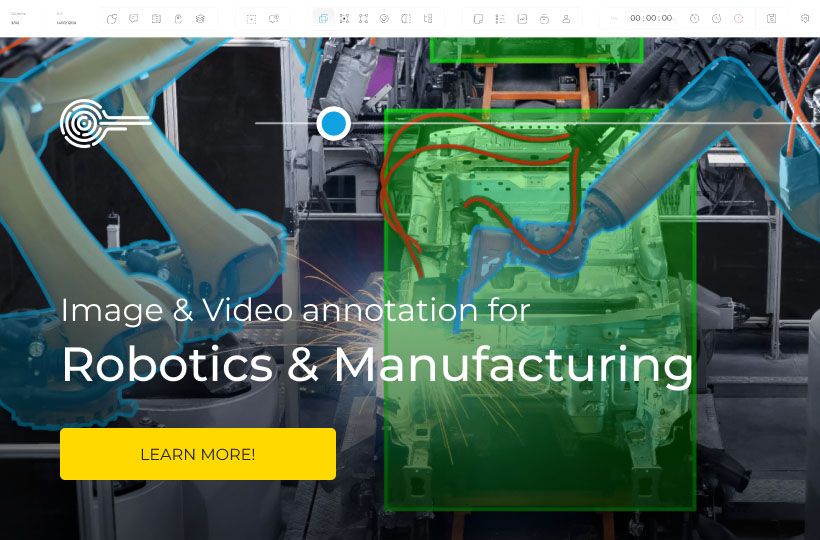
Embodied AI systems must perceive their environment, understand spatial relationships, manipulate objects, and make real-time decisions. These systems power robotics, autonomous vehicles, warehouse automation, industrial machinery, and human-machine interaction platforms.
Data collection for embodied AI is more complex, requiring synchronized multimodal sensor streams, temporal consistency, environmental diversity, and real-world interaction data that accurately reflects physical behavior. Building these datasets involves robotics, sensors, modeling environments, annotation workflows, synchronization pipelines, and a large-scale data management infrastructure.
Quick Take
- Embodied AI systems require multimodal real-world interaction data.
- AI data collection methods combine real, synthetic, and human-guided approaches.
- Real-world datasets improve model robustness and generalization.
- The quality of synchronization and annotations affects the performance of embodied AI.
- Human-in-the-loop systems remain essential for complex robotics workflows.

Components of data acquisition with embodied AI
Modern embodied AI systems rely on multimodal data channels that collect synchronized information from robots, sensors, and the environment. These channels combine different sensor modalities to help AI systems understand spatial relationships, object interactions, motion, and environmental dynamics in real time.
Temporal data collection
Embodied AI systems operate continuously over time, making temporal consistency important. Temporal recording allows models to learn how actions evolve dynamically and how decisions affect future states.
Such datasets include:
- Sequential motion data.
- Action trajectories.
- Interaction chronologies.
- State transitions.
- Environmental changes.
Human demonstration data
Many robotic systems are trained using simulation-based and demonstration-based learning.
Annotators can perform tasks while robots record:
- Motion trajectories.
- Hand movements.
- Object interactions.
- Task sequences.
- Grasping strategies.
This data is valuable for robot manipulation and long-term task training.
AI data collection methods
Modern embodied AI systems rely on multiple AI data collection methods, depending on operational requirements and security constraints. Organizations combine multiple data collection approaches to create diverse and robust training datasets. Each method offers distinct benefits and enhances the robustness of embodied AI models.
Real-world data collection
Real-world data collection captures authentic environmental behavior, realistic sensor characteristics, and complex physical interactions that are difficult to recreate artificially. These datasets include natural lighting conditions, human unpredictability, real sensor noise, environmental variability, and dynamic interaction scenarios, helping AI systems generalize across production environments.
Such data is needed for robotic applications, but collection is often expensive and time-consuming, requiring physical robotic platforms, sensor infrastructure, operational supervision, and advanced annotation workflows.
Simulation-based collection
Simulation environments support the creation of controlled environments, synthetic sensor streams, sparse scenario generation, and large-scale trajectory recording.
Use digital twins and physics engines to simulate realistic robotic behavior and interactions with the environment. These environments help accelerate AI development, enable rapid testing, and generate scalable datasets. However, translating simulations to the real world remains a challenge, as simulated physics, lighting, textures, and sensor behavior may not match real-world conditions, thereby reducing model generalization performance after deployment.
Human-in-the-loop collection
Human experience remains important in many AI-embodied data pipelines. This approach is used for manual demonstrations, annotation validation, edge case testing, safety monitoring, and failure analysis.
Human-in-the-loop workflows are important for safety in robotics applications, where annotation accuracy is essential for developing reliable artificial intelligence systems.
Real-world datasets for embodied AI
Real-world datasets improve model robustness and generalization. Embodied AI systems must operate in a variety of environments, including:
- Indoor and outdoor environments.
- Day and night conditions.
- Weather variability.
- Dynamic obstacles.
- Human interaction scenarios.
- Cluttered environments.
Collect data from different geographic regions, environmental conditions, and operational scenarios to improve generalization.
Multimodal synchronization
A critical aspect of embodied AI data collection is the synchronization of sensor streams. Even small timing discrepancies degrade perception quality and negatively impact sensor fusion performance.
Synchronization pipelines include:
- Timestamp alignment.
- Coordinate transformation.
- Sensor calibration.
- Frame interpolation.
Synchronization improves model performance during processing.
Annotations for embodied AI data
Embodied AI datasets require highly specialized annotation workflows that go well beyond traditional image labeling.
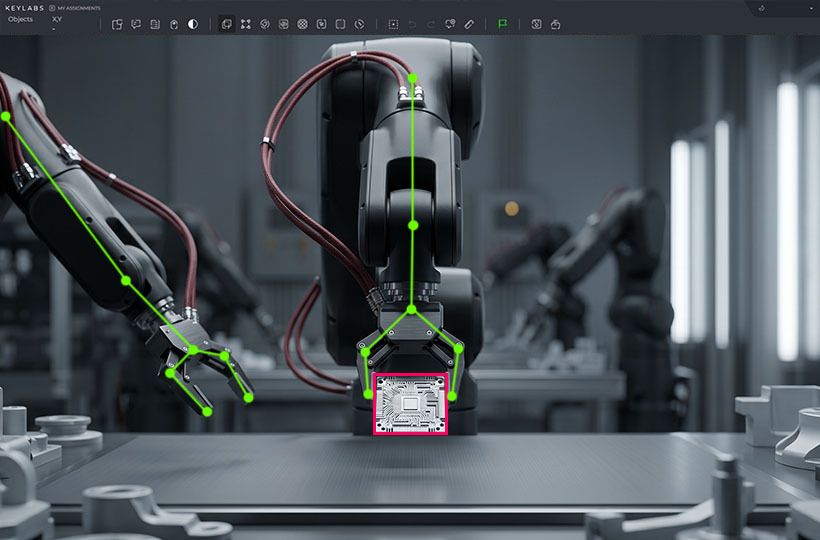
Robotics annotations include 3D object labeling, trajectory annotation, pose estimation, temporal segmentation, action labeling, interaction tracking, and sensor fusion validation. These annotations teach AI to understand how objects move in space, how robots interact with their environment, and how actions evolve in synchronized multimodal sensor streams.
Embodied AI annotations involve continuous sequences rather than individual frames. Annotators label object positions over time, validate robot motion trajectories, track human-robot interactions, or verify the consistency of camera, lidar, radar, and telemetry data. This makes annotation complex and resource-intensive.
For scalability, AI-based annotation systems are relied upon to automate repetitive labeling tasks, while validators handle edge-case and temporal-consistency checks.
Practices for data acquisition with embodied AI
- Prioritize Data Diversity
Collect data from a variety of environments, weather conditions, object types, and operational scenarios for better generalization.
- Combine real and synthetic data
Hybrid acquisition improves scalability while maintaining realistic training conditions.
- Design for multimodality
Ensure synchronized data acquisition across cameras, LiDAR, telemetry, and other sensor systems.
- Automate where possible
Use AI-powered preprocessing and annotation systems to improve scalability and reduce manual workload.
- Maintain quality control
Implement validation pipelines, synchronization checks, and human review systems to maintain the dataset's quality.
FAQ
What is data acquisition robotics?
Data acquisition robotics refers to systems and infrastructure used to collect multimodal sensor and interaction data from robotic platforms.
Why are real-world datasets important for embodied AI?
They help AI systems generalize better to dynamic environments and realistic operational conditions.
What are common AI data collection methods in robotics?
Common methods include real-world data collection, simulation environments, fleet learning, and recording human demonstrations.
Why is sensor synchronization important?
Synchronization ensures that multimodal sensor streams align correctly for accurate perception and sensor fusion.
What challenges exist in embodied AI data collection?
Major challenges include scalability, annotation complexity, environmental diversity, and simulation-to-real transfer.