Top physical AI trends
For a long time, artificial intelligence existed in the form of chatbots, image generators, and recommendation algorithms. However, today we are witnessing a transition from digital AI to Physical AI. This is the integration of intelligent algorithms into robots' physical bodies, enabling them to perceive the world, interact with it, and learn in real time. In this article, we will examine the key trends in Physical AI that are transforming robotics from programmable machines into autonomous agents.
Quick Take
- The shift to embodied intelligence. The foundation of AI innovation today is the shift from purely digital models to physical AI, where intelligence is embedded in the bodies of robots.
- Multimodality is essential. Current trends in AI-based robotics prioritize combining vision, touch, and sound so that robots can operate in unprepared, real-world scenarios.
- Transient computing as a reflex. For safety and speed, AI processing is being moved "onboard" via neural processing units (NPUs), reducing latency to near zero and enabling true autonomy.
- The rise of humanoids. Projects like Tesla Optimus and Figure 01 are proving that humanoids are no longer prototypes, but the driving force behind the future of automation.
- Safety through explainability. As robots exit industrial cages, embodied intelligence trends focus on "Explainable physics" and proactive collision avoidance to ensure safe human-robot collaboration.

From hard-coding to end-to-end learning
Traditionally, robots were programmed on a task-action basis. For a robot to pick up a cup, an engineer had to write down every coordinate of the movement. Physical AI changes this paradigm with end-to-end learning.
- Imitation learning. Robots learn by observing human actions through video or VR interfaces.
- Deep reinforcement learning. A robot makes millions of attempts in a simulation, receiving rewards for successful task completion.
This allows robots to cope with unstructured environments—for example, picking up objects of different shapes and textures that they have never encountered before.
Foundation models for the physical world
We all know about LLMs (Large Language Models) like GPT-4. Now comes Large Behavior Models (LBM). These are foundational models trained not on text but on data about movement, sensory inputs, and interactions with the physical world.
- Multimodality. Modern physical agents simultaneously process visual (vision), tactile (touch), and audio (voice) data.
- VLA models (Vision-Language-Action). Models (such as Google DeepMind's RT-2) that understand the command "bring something useful for breakfast" are able to identify an apple among a pile of garbage and physically pick it up.
Sim-to-real
The trend of simulation into reality has become a catalyst for modern robotics, solving a fundamental problem. Training physical AI in real conditions is slow and expensive. This is accompanied by the risk of mechanical breakdowns, equipment wear and tear and threats to personnel.
In contrast, the concept of digital twins allows you to transfer the entire training process to a virtual space. Using physics engines such as NVIDIA Omniverse or Isaac Sim, developers create photorealistic copies of factories, warehouses or city streets, where the laws of gravity, friction and lighting are identical to those on Earth.
The basis of this method is scalability and acceleration of time: in a simulation, a robot can complete its course, performing millions of trials simultaneously on thousands of virtual copies, which in the real world would take decades. However, the main problem here remains the gap in reality. It's those tiny differences between virtual physics and the real world that can confuse an algorithm. To overcome this barrier, engineers use domain randomization, intentionally introducing noise into the simulation by changing lighting, textures, or friction.
Humanoid revolution
In 2024-2025, humanoid robots have left scientific laboratories and entered real-world production sites. Thanks to Physical AI, these machines have become autonomous agents capable of learning.
- Tesla Optimus (Gen 2). This is a testing ground for the neural networks used in TeTesla'sutopilot. Today, this robot no longer walks around the shop; it autonomously sorts battery cells at the company's factories, using only visual data and tactile sensors. The end-to-end learning model allows it to adapt to new tasks without writing a single line of code, just by demonstrating the action to a human operator.
- Figure. Thanks to a partnership with OpenAI, the Figure robot has become the first humanoid to demonstrate natural speech in real time in parallel with physical actions. In the video, the robot not only serves a person an apple in response to the request "give me something to eat," but also explains why it chose this particular item while simultaneously clearing the table of trash.
- Boston Dynamics Atlas (All-Electric). By abandoning hydraulics in favor of electric drives, the new Atlas has become the embodiment of superhuman mobility. This robot uses Physical AI to perform maneuvers beyond a person's power. For example, it can rotate its torso 360° or get up from the floor in ways that seem like futuristic acrobatics. This allows it to work in confined warehouse spaces.
Edge sensing
For AI to become truly physical, it must ‘’feel’’, is where the trend toward creating robotic skin with a high density of pressure sensors comes from.
These are flexible polymer materials packed with thousands of microscopic sensors:
- Capacitive and piezoresistive sensors. They respond to the slightest pressure change, allowing AI to distinguish between a ripe peach and a stone.
- Optical tactile sensors. Inside the mechanical finger is a camera that captures the deformation of the soft gel from the inside. AI analyzes this image and "sees’’ the imprint of the object at micron-level resolution, even detecting scratches on metal.
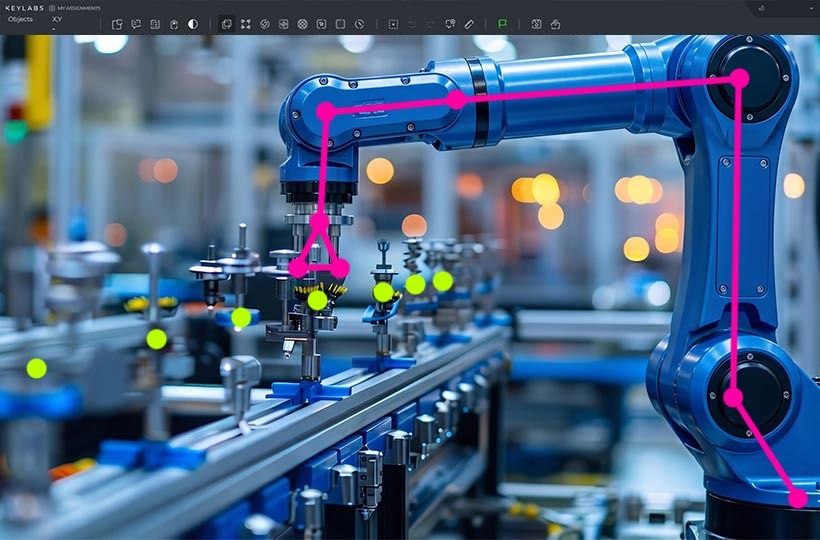
The evolution of edge computing
Physical AI processes these microsignals, allowing the robot to hold a fragile egg without breaking it or to tighten a screw in a work area where the cameras cannot see.
Tactile intelligence is inextricably linked to proprioception. In humans, it is the ability to sense the position of one's hand with one's eyes closed. For physical AI, this means integrating data from all joints and actuators into a single kinesthetic model.
The development of artificial intelligence depended on the power of large data centers. However, for physical AI, the concept of a "cloud brain" is not suitable due to signal delay (latency). However, for physical AI, the concept of a "cloud brain" is not suitable due to signal delay. Delay in data transmission over the internet can lead to a catastrophic collision before the cloud has time to send a command.
This provoked the transition to edge computing, which is the transfer of computing power to the hardware of the robot.
Thanks to the emergence of specialized neuroprocessors (NPUs) that mimic the architecture of the human brain, robots can process gigabytes of sensor data locally. This makes the systems lightning-fast, and ensures their complete autonomy.
Cloud AI vs. Edge AI in robotics
Safety and ethics of physical interaction
The safety and ethics of physical interaction are a challenge for modern robotics. Today, robots are integrated into the space we share, which changes the requirements for their software. The key concept is Collaborative AI (Cobots) intelligence that can see a person as an obstacle and predict their intentions. This means that the system must have dynamic trajectory prediction: if you suddenly reach for a part, the AI must, in fractions of a millisecond, calculate its movement to avoid a collision. Such interaction requires high sensitivity and social intelligence of the machine, which learns to recognize gestures and facial expressions as signals to change behavior. Here there is a need for explainable physics. In the event of an incident, developers and regulatory authorities need to understand why the AI made a particular physical decision at a given moment. Unlike "black boxes’’, modern physical AI must be able to reconstruct the chain of its thoughts from the received sensory data to the final motor impulse. This is a legal requirement for incident investigation, and a fundamental ethical aspect.
FAQ
What are the most important trends in AI robotics for 2026?
Trends include the mass adoption of humanoid forms, the shift from pre-programmed movements to end-to-end neural networks, and the integration of haptic sensor systems.
How are AI innovations changing the future of automation?
Today, AI innovations are enabling machines to cope with unpredictability. From autonomous logistics drones to AI-powered kitchen assistants, the focus has shifted from “task automation” to “reasoning automation” in the physical world.
What does “embodied intelligence” mean?
Embodied intelligence trends refer to the concept that true AI requires a physical body to interact with the real world. Unlike ChatGPT, which exists only in code, embodied AI learns through physical constraints - gravity, friction, and touch.
Why is edge computing important for the future of robotics?
In the future of automation, latency is a safety issue. If a robot relies on the cloud, a 100ms delay can lead to a collision. Edge computing allows AI innovations to happen “on-device,” allowing robots to process visual and tactile data, ensuring their reliability without an internet connection.
Will humanoid robots become part of our daily lives?
Current trends in embodied intelligence show humanoid robots such as Tesla Optimus and Figure 01 are already being tested in factories and pilot deployments.