Achieve ISO 42001 Compliance for Data Annotation
The ISO 42001 standard is the world's first international guidance that helps companies create, develop, and monitor artificial intelligence systems safely and responsibly. In the field of data labeling, this standard requires that every stage of training dataset preparation be fully transparent, documented, and protected against errors and information leaks. Having a certified labeling partner allows AI system developers to seamlessly pass external audits and verify the safety of their models.
Quick Take
- In the field of labeling, the AI management system is responsible for access security, instruction versioning, and systemic QA quality metrics.
- Practical AI governance protects training datasets from two main threats – systemic bias and the loss of data lineage.
- Real audit readiness is based on automatic logging of annotator actions, calculating inter-annotator agreement, and instruction versioning.
- The process of obtaining a certificate consists of four steps: gap analysis, policy implementation, internal testing, and a final external audit.

AI Management in Labeling Processes
The Role of the AI Management System in Data Preparation
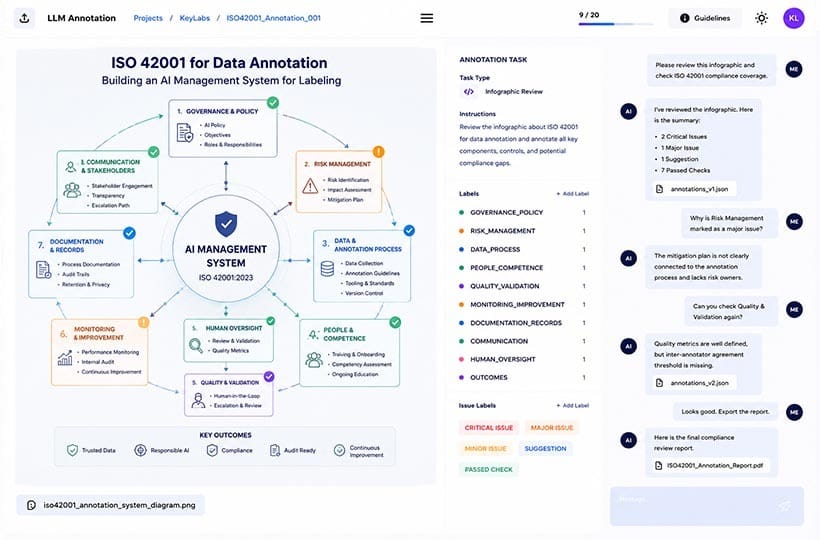
An Artificial Intelligence Management System (AIMS) is a clear set of rules, tools, and processes within a company that guarantees AI development does not get out of control. When applied to the data labeling pipeline, the AIMS manages the entire path a file takes from a raw snapshot to a finished annotation.
Within the scope of data annotation, the AIMS primarily performs three tasks:
- Access Control and Security. It clearly defines which markers have access to confidential data (for example, medical images or personal data from autopilot cameras) and where this data is stored.
- Standardization of Instructions. The system requires that labeling rules be clearly described and leave no room for ambiguity, which minimizes human error.
- Quality Metrics. The AIMS captures the percentage of discrepancies between annotators and the results of checks by QA engineers, making the error correction process systemic.
Thanks to the implementation of an AIMS, a company gains a complete picture of its data operations. This serves as the primary foundation for preparing the business for certification and ensuring continuous audit readiness for partners or regulators.
How to Set Up AI Governance in Labeling Processes
Artificial intelligence governance in the labeling process is the practical application of rules that guarantee the quality, ethics, and legality of data usage. It transforms the chaotic work of annotators into a rigorous technological process where every step can be tracked and verified.
The main task of AI governance in practice is to manage two primary data preparation risks: bias and the loss of data lineage.
Thanks to such detailed control over data provenance and the systemic fight against bias, a company creates high-quality datasets and makes its product transparent for future auditing.
Practical Steps to Certification
The main prerequisite for successful certification under the ISO 42001 standard is the full synchronization of your internal labeling processes with AIMS requirements. A company must visually prove that every stage of data processing is monitored, recorded, and analyzed for risks. The path of a data service provider or an internal ML team to officially obtain a certificate consists of several consecutive stages:
- Gap Analysis. Comparing current labeling processes with ISO 42001 requirements. At this stage, it is identified exactly where the data pipeline lacks control, logging, or clear instructions for annotators.
- Policy Development and Implementation. Creating documented instructions: from security rules when working with confidential client data to methodologies for minimizing bias in datasets.
- Internal Audit and Testing. The team conducts its own check to ensure that managers, markers, and QA engineers act strictly according to the new instructions, and that annotation tools correctly preserve data lineage.
- Official Certification Audit. An external accredited organization verifies documentation, interviews the team, and analyzes random datasets for compliance with the standard. Upon successful completion, the company receives a certificate.
How to Build Audit Readiness for a Data Pipeline
The basis of real readiness for inspection is the presence of indisputable digital evidence – detailed logs of user actions and documented quality control metrics. A third-party auditor will not take your word for it; they need clear reports confirming the security and accuracy of each annotation.
To pass the audit without findings, the preparation of tools and instructions must cover three areas:
- Logging in Labeling Tools. Your annotation platform must automatically capture a full digital trail. This includes information on which exact annotator worked with the file, how much time it took, what corrections the QA engineer made, and which version of the instruction was active at that moment.
- Documenting Error Metrics. It is necessary to collect analytics regarding inter-annotator agreement and detailed reports on errors detected during automatic and manual quality checks. This proves to the auditor that your QA system operates effectively.
- Instruction Management. All instructions for annotators must have clear version numbers. If object marking rules change during a project, the system must clearly record which files were marked under the old version and which were marked under the new one.
FAQ
Does compliance with ISO 42001 guarantee the complete absence of bias in a dataset?
No, the standard cannot completely eliminate human or technical factors, but it forces a company to establish a systemic mechanism for identifying and minimizing these risks. ISO 42001 requires the presence of clear bias assessment metrics, regular dataset testing, and documented instructions that minimize the subjective influence of annotators.
What is the difference between ISO 42001 and ISO 27001 in the context of data operations?
ISO 27001 focuses exclusively on information security, data leak protection, and access control. The ISO 42001 standard is broader: in addition to security, it evaluates specific artificial intelligence risks – model training quality, ethical AI usage, algorithm transparency, data pipeline management, and the minimization of systemic errors.
How often do you need to update the AIMS and undergo a repeat audit?
After receiving an official certificate, a company must undergo a surveillance audit annually to confirm that the AI management system functions without failure. Full recertification occurs every three years. However, internal labeling and risk assessment instructions are updated more frequently – each time the technology stack changes or new types of AI models are launched.
Is it possible to certify an individual data labeling project?
The ISO 42001 standard is designed for certifying an organization or a specific branch/department that manages AI processes. However, within the scope of building an AIMS, a company can clearly define the boundaries of application. This means you can implement and certify the rules of the standard strictly for a specific direction – for example, solely for the department preparing training data for autonomous transport.