Training Data Copyright Compliance: TDM Opt-Outs & Licensed Datasets in 2026
Ignoring copyright rules when creating datasets threatens AI developers with legal action, millions in fines, and court demands for "model unlearning" (the forced removal of knowledge or the destruction of model weights trained on unlicensed data).
In this article, we will analyze how approaches to data jurisdiction have changed, why text and data mining (TDM) mechanisms have become the basis of European regulation, and how the combination of opt-out signals and licensed data protects businesses from legal risks.
Quick Take
- With the entry into force of the EU AI Act and court decisions, AI developers are required to read and respect rightsholder opt-outs automatically.
- Machine-readability is the only legal criterion. Opt-outs must be conveyed through technical protocols (e.g., robots.txt, ai.txt, TDM Reservation Protocol, or meta tags).
- In the US, the fair use doctrine is the main protection for developers, but it separates the learning process and the origin of the data.
- Licensed Data is the new norm. The market has shifted towards Rights-Cleared and Clean-Room Datasets.

Text and Data Mining (TDM) and the Opt-Out Mechanism in the EU
In the European Union, the basis for regulating data parsing is Article 4 of the EU Directive on Copyright in the Digital Single Market (DSM Directive). It allows text and data mining (TDM) to extract text and data from lawfully available sources, unless the copyright holder has prohibited such use.
According to the EU AI Act, developers of generative AI models are required to:
- Implement technologies to detect data opt-outs.
- Publish a detailed summary of the materials used for training.
What is considered a proper Opt-Out?
Case law has formulated the rule that the refusal must be machine-readable. If the copyright holder has indicated in the user agreement (Terms of Service) "Use for training AI is prohibited", crawler developers are not obliged to search for this text manually.
Protection is considered valid if the following is applied:
- Robots.txt file blocking specific AI bots.
- Specialized meta tags or ai.txt configuration files.
- TDM Reservation Protocol (TDM-RP) standard in HTTP Response Headers.
- Machine-readable C2PA manifests ("Do Not Train" metadata).
American Approach: The Limits of Fair Use in Court Cases
The US lacks a single statutory TDM Opt-Out mechanism similar to the EU directives. Instead, developers rely on the fair use doctrine under Section 107 of the US Copyright Act.
The main legal rule in the US
- Courts separate the learning process from the way the data was obtained (Data Provenance).
- Transformative Nature of Learning. Courts recognize that analyzing text to extract abstract patterns, linguistic connections, and concepts is a transformative use (fair use), since the model does not replace reading the original book for entertainment.
- Clean Acquisition. If a developer downloaded content from a pirated source, fair use protection is nullified.
In Bartz v. Anthropic, the company proved transformative learning, but was forced to pay massive compensation and destroy datasets precisely because the original source of copying was pirated.
The Shift to Licensed Data
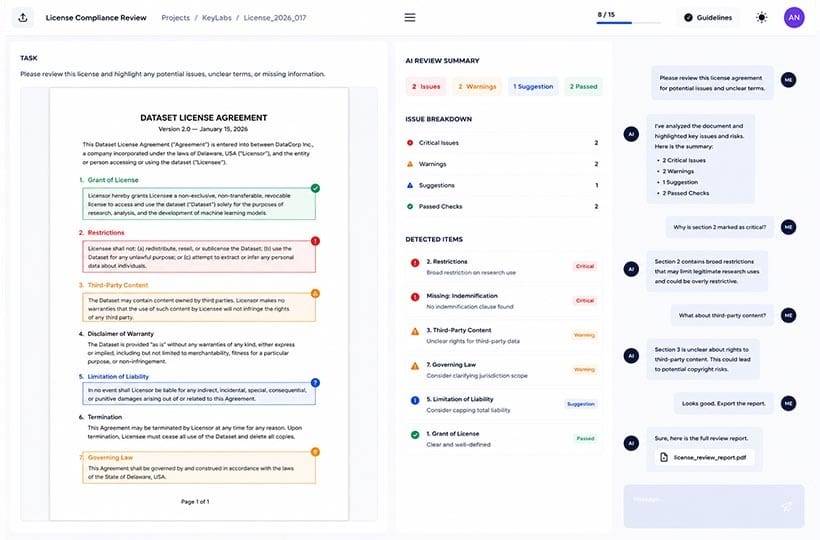
Large technology companies, the corporate sector, and startups are shifting to licensed data and the development of Clean-Room Datasets.
Benefits of using licensed data:
- Indemnification. The data provider guarantees that all authors have provided consent and the materials are free of copyright.
- Data Provenance. Using a clear audit trail ensures that models are not subject to judicial "unlearning".
- Higher quality and structure. Unlike haphazard web scraping, licensed datasets come with high-quality 3D, text, or multimodal markup.
Keylabs and Custom Data Collection
When web scraping becomes risky due to TDM Opt-Outs and ready-made datasets do not cover specific edge cases, the only way is to create content from scratch — Data Creation and Data Collection.
This is where the Keymakr ecosystem and its annotation platform, Keylabs, come to the rescue.
How does this ensure 100% compliance with copyright laws?
- Legal custom data collection (Data Collection). Instead of parsing other people's materials from the Internet, Keymakr organizes the collection of primary data (images, videos, audio, and texts) using its own network of authors and sensors. All participants in the collection sign official consents (User Consent Agreements & Model Releases). The data is collected with full alienation of property rights in favor of the client (Rights-Cleared), thereby completely removing the risk of copyright or privacy claims.
- Synthetic data creation (Data Creation). For tasks where collecting real data is difficult or expensive, Keymakr uses synthetic data generation methods. They create controlled 2D/3D environments from scratch, which guarantees the absence of any claims to someone else's intellectual property.
- Organization of processes on the Keylabs platform. All collected or generated materials are marked up and validated on the Keylabs platform.
The platform allows
- To store a complete history of the origin of each file (Data Provenance Audit Trail).
- To control the quality level (QA) in several stages.
- To guarantee that no element of unauthorized content will get into the final training dataset.
FAQ
If I have published an article online, do I have the right to request that my data be removed from an already-trained AI model?
EU law and US case law state that if your Opt-Out was set after the model has finished training, the developer is not obliged to remove the model. However, he is obliged to remove your data from future data collection iterations and new versions of the model (Retraining/Fine-tuning datasets).
Does the robots.txt file protect against absolutely all AI bots?
According to the EU AI Act and Codes of Practice, failure to comply with robots.txt by commercial AI crawlers is a violation of the law and deprives the developer of protections except for TDM.
What is the difference between a Perpetual and Term-Limited Data License?
A Perpetual License grants the right to use the content for training a model forever. A Term-Limited License grants the right to use the data only for a specified period (e.g., 3 years).
Is the creation of AI content a copyright infringement if the model was trained on protected data?
Training on data and the resulting output are two distinct legal issues. If the output is a virtually exact copy of the original work (the so-called memorization issue or overfitting), this may be considered a copyright infringement. That is why developers implement technical filters against duplication of originals.