AI-Driven vs Manual ADAS Annotation
The safety and reliability of modern advanced driver assistance systems (ADAS) directly depend on the onboard computer's ability to instantly and flawlessly interpret the road environment. Creating effective artificial intelligence for the automotive industry has long moved beyond purely architectural engineering competitions in building neural networks.
Today, the primary foundation of autonomous and semi-autonomous driving is the quality of the source information, as any advanced perception model remains helpless without colossal volumes of accurate, diverse, and detailed data. It is precisely the flawless markup of baseline datasets that determines how successfully a vehicle will execute cognitive tasks critical to the lives of passengers and pedestrians. This includes automatically keeping the vehicle within its traffic lane, instantly detecting and classifying static or dynamic road obstacles, and recognizing traffic signs under any weather conditions.
Quick Take
- The success of ADAS systems depends on the volume and flawless quality of large masses of annotated data.
- Fully autonomous AI markup offers maximum speed and scalability, but carries risks of systemic hallucinations and non-compliance with the ISO 26262 standard.
- The AI-assisted annotation format is the most balanced, as it combines the speed of machines with human precision.
- A modern annotation pipeline automates every step – from smart frame filtering during data collection to automatic 3D anomaly discovery at the quality control stage.

ADAS Data Use Cases
Flawlessly prepared and validated ADAS datasets are the foundation for implementing active safety systems in production vehicles. Thanks to the correct combination of geometry and semantics, intelligent systems assist the driver in real time, preventing accidents in the most common driving scenarios.
Automation Scenarios and Markup Types
Each function of a modern autopilot relies on a specific set of marked data that trains the perception model to see concrete types of road objects:
- Highway Assist. This system takes over control of the vehicle during long-term driving on high-speed highways. For its stable operation, marking lane boundaries using polylines is critically important. The AI must clearly see lane limits, solid and dashed lines, as well as edge guardrails, even under conditions of night driving or worn-out road surfaces.
- Autonomous Parking. A function that requires millimeter maneuvering precision from the car in the ultra-tight spaces of underground parking lots or garages. Here, developers use integrated markup of cameras, radars, and LiDARs, where each car, pillar, or wall is enclosed in three-dimensional bounding boxes – cuboids. This allows the parking AI to correctly evaluate the volumetric dimensions of obstacles.
- Automatic Emergency Braking. A safety feature that saves lives in the event of a sudden obstacle appearing ahead. It is trained on the basis of large volumes of a pedestrian detection dataset and object detection labeling. When the system recognizes a child running out onto the road or a car that has braked sharply ahead, it instantly activates the brakes without driver intervention.
- Adaptive Cruise Control. A system that automatically maintains a safe distance from the vehicle moving ahead, adjusting the car's speed. To achieve this, neural networks are trained using flat and volumetric frames that capture the dimensions of vehicles ahead and help radars precisely calculate closing dynamics.
- Traffic Sign Recognition. The AI model constantly scans the space above the road and the roadsides to timely detect speed limit, priority, or warning signs. Recognition accuracy is ensured by high-quality object markup, where each sign is classified by type and condition, allowing the machine to duplicate important information on the instrument panel for the driver.
- Urban Driving. The most complex scenario, which combines the operation of all ADAS systems simultaneously. Driving in a city requires the vehicle's ability to orient itself among thousands of chaotic objects: pedestrians, scooter riders, temporary traffic cones, and complex intersection layouts.
Only an end-to-end and detailed annotation pipeline allows for preparing the AI for the unpredictable behavior of urban traffic participants. This guarantees that in the real world, the vehicle will react to danger in fractions of a second, ensuring the maximum level of protection on any journey.
Manual Labor vs. AI-Driven Annotation for Autopilot Data
The speed of developing autopilot systems directly depends on how effectively engineers can process gigabytes of raw information from roads. The choice of data preparation methodology determines both the financial budget of the project and the time-to-market of the finished vehicle. A comparison of classic manual labor and modern automated platforms allows one to clearly see exactly how technology is changing approaches to training AI.
Manual Annotation
The classic approach to creating ADAS datasets relies entirely on human labor, where specialists independently process each frame. When developers need an accurate pedestrian detection dataset, an annotator manually outlines each silhouette figure on the screen. This method ensures high quality, but becomes a serious barrier to rapid perception model training.
Advantages of the manual approach:
- High precision. The human eye flawlessly determines object boundaries even under conditions of poor lighting or partial occlusion of objects.
- Effective handling of edge cases. A human is capable of instantly orienting themselves in a non-standard situation, for example, correctly recognizing an unconventional trailer or a pedestrian in a bulky costume.
- Strict quality control. Manual verification guarantees that object detection labeling will fully comply with rigid international ISO 26262 data requirements.
Disadvantages of the manual approach:
- High cost. Involving large teams for routine work requires colossal financial expenses.
- Low speed. The marking process is monotonous and time-consuming; manual lane detection annotation on thousands of hours of video can last for months.
- Difficulty in scaling. It is virtually impossible to increase dataset production volumes without a proportional and expensive expansion of staff.
AI-Driven Annotation
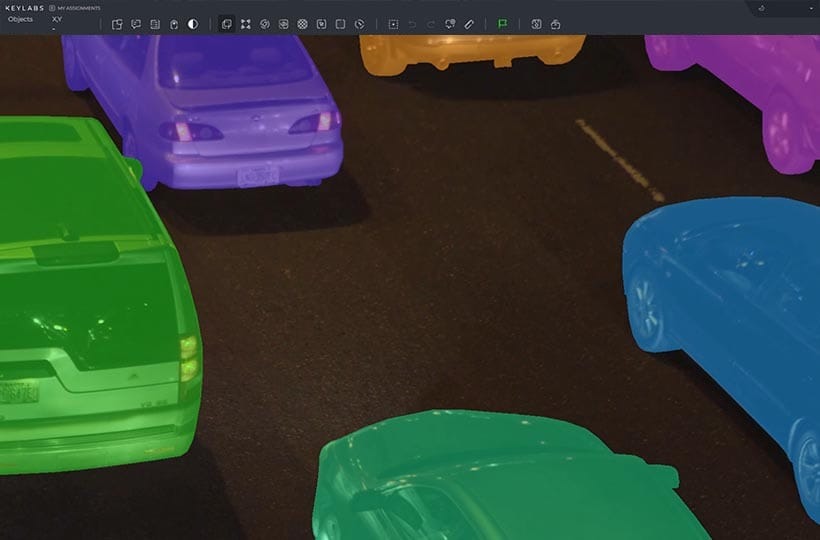
The highest degree of automation in dataset preparation is the transition to fully autonomous markup using artificial intelligence, where large cloud models independently execute the entire end-to-end marking cycle without involving human hands to draw lines or frames. This approach utilizes ultra-powerful neural network ensembles to simultaneously analyze video streams and LiDAR point clouds, transforming raw arrays into finished data packages. Fully autonomous label generation creates new opportunities to accelerate perception model training, but has its own technological limitations.
Advantages of fully autonomous AI markup:
- Colossal cost reduction. Excluding human annotators from the production chain ensures the maximum reduction in markup costs, making the processing of gigabytes of data cheap.
- Instant scaling. AI is capable of marking millions of frames of raw ADAS datasets around the clock in the cloud, delivering finished results in a matter of days instead of months of manual labor.
- Ideal 3D geometry. Large models flawlessly calculate spatial coordinates, automatically transforming complex line markup and volumetric cuboids from LiDAR clouds back onto 2D camera frames.
Disadvantages of fully autonomous AI markup:
- The problem of systemic hallucinations. An autonomous model can stably repeat one and the same error across thousands of frames in a row (for example, perceiving a specific shadow as a concrete curb), which can poison the entire training dataset.
- Blindness to unique anomalies. Fully independent AI often fails before new, non-standard situations on the road that have not been encountered previously in its algorithms, missing important details.
- Risk of ISO 26262 non-compliance. Without a final audit by a human, data fully generated by a machine lacks legal confirmation of safety and cannot unconditionally meet strict requirements.
AI-Assisted Annotation
The modern labeling workflow automation industry bets on smart annotation pipelines where AI assists humans. The process begins with a pre-labeling stage, during which a baseline neural network automatically places rough marks on lines or objects. After this, a human operator merely checks the finished result and corrects algorithmic inaccuracies.
Advantages of the AI-assisted approach:
- Extreme speed. Algorithms are capable of generating thousands of rough sketches, lines, and three-dimensional boundaries in a matter of seconds.
- Flexible scaling. The technology allows for the effortless processing of millions of frames thanks to the automatic selection of unique road scenes through active learning systems.
- Economic benefit. Routine automation delivers a radical annotation cost reduction, freeing up human resources for the final audit of data.
Disadvantages of the AI-assisted approach:
- Errors of the baseline model. Artificial intelligence can miss objects, confuse shadows with obstacles, or allow inaccuracies in complex geometry.
- Mandatory need for validation. Because the system prepares data for road safety, automatically generated labels cannot be sent into production without a thorough final check by a human.
Modern Annotation Pipeline
The basis for rapid training of modern autonomous driving systems is a standardized and high-tech annotation pipeline. Instead of chaotically passing files from one annotator to another, the modern industry uses end-to-end labeling workflow automation. This transforms data preparation into a clearly controlled conveyor line, where each stage is reinforced by AI algorithms, allowing human routine to be minimized and critical errors to be excluded.
Pipeline Stages and the Role of Automation
A typical data preparation life cycle within a smart pipeline consists of sequential steps, at each of which automation plays a decisive role:
- Data Collection. Special laboratory vehicles record gigabytes of raw information from the streets. Role of automation: Smart onboard algorithms cut off duplicates and empty frames (for example, hours of standing at a traffic light) already at the recording stage, saving server space.
- Synchronization. Streams from cameras, radars, and LiDARs are combined into a single coordinate system. Role of automation: Software automatically aligns data by millisecond timestamps so that each 2D frame on a video clearly corresponds to a 3D point cloud in space.
- Pre-labeling. Raw files pass through baseline neural networks. Role of automation: AI independently places initial geometry – it overlays 2D/3D bounding boxes, builds volumetric cuboids around cars, and plots road marking lines.
- Human Review. Professional annotators connect to the process. Role of automation: The markup platform highlights for the human only those zones and objects in whose collisions or accuracy the pre-labeling algorithm detected the slightest uncertainty.
- QA. Validation specialists verify the accuracy of the previous link's work. Role of automation: Scripts automatically look for geometric anomalies (for example, a car cuboid "hanging" in the air or fallen under the asphalt) and instantly return such frames for rework.
- Dataset Validation. A final assessment of the readiness of the entire data array. Role of automation: Systems verify the compliance of packages with strict safety standards and secure coding, guaranteeing the absence of systemic biases or critical omissions.
- Model Training. Data is automatically imported into the training loop. Role of automation: The cleaned and marked array triggers the final process of perception model training through automated CI/CD pipelines without the need for manual intervention by engineers.
Thanks to this process design, where automation accompanies data from the camera on the bumper to the final model code, companies manage to maintain a continuous update cycle for autopilot software. The smart pipeline minimizes the human factor where speed is needed, and maximizes its value where a final expert quality assessment is required.
FAQ
How is the model's "confidence" level calculated in a hybrid pipeline to hand over a frame for human review?
To evaluate the confidence of a baseline model during automatic markup, statistical probability metrics are used, such as distribution entropy or softmax coefficients of the neural network's final layer. If the AI classifies an object with a confidence indicator below a given threshold, the system automatically marks this frame as doubtful. The data management platform instantly redirects such defective or ambiguous elements into the work queue of a human annotator for manual correction.
How do pipeline automation tools handle the problem of dataset version conflicts when markup requirements change mid-project?
Modern markup platforms utilize data versioning systems, analogous to Git for software code, which allows for creating different branches of a single dataset. Workflow automation allows for overlaying new markup rules as an additional automatic layer on top of already existing labels. Automation scripts trigger a repeated pre-labeling process only for the specific new class of objects, minimizing the need to restart the entire pipeline from scratch.
How do fully autonomous markup AI models handle optical illusions, such as the image of a person on an advertising billboard?
Fully autonomous markup models often fail when encountering two-dimensional images of people or cars on posters, marking them as real participants in road traffic. To eliminate such errors, cloud algorithms use spatial analysis of temporal sequences and data from LiDARs. The AI compares the flat image from the camera with the zero volumetric point density of the LiDAR in the exact same coordinate and automatically classifies the object as an element of background infrastructure, preventing false triggering of braking systems.
How do automated QA systems detect semantic segmentation errors when the AI "creeps" road markup onto the sidewalk?
Automated quality control scripts utilize topological correctness verification and pre-written geometric rules. For example, the algorithm knows that the class "road lane" cannot intersect with the class "building" or enter territory that, according to LiDAR elevation map data, is raised above the asphalt level as a sidewalk. If the script detects a logically impossible overlap or mutual penetration of masks of different objects, the system automatically rejects the data package and returns it to the manual correction stage.
How does the process of annotating polylines adapt to the markup of complex multi-level interchanges and overpasses?
When marking complex engineering structures, ordinary two-dimensional lines become ineffective, so the pipeline transitions to working with 3D polylines. Automated algorithms track three-dimensional vectors of the roadway, separating traffic lanes into different height levels. This allows the navigation and lane-keeping system to clearly understand which exact markup belongs to the current overpass and which lines pass below – on the ground level of the interchange.