LLM Trends That Will Define the Future of AI
LLMs are a key component of modern AI systems and are gradually moving from general-purpose generative models to the infrastructure level, where they serve as universal interfaces to knowledge, data, and software environments. Their development is determined not only by increases in parameter scales but also by architectural, algorithmic, and system optimizations.
Analysis of current research and industrial practices shows that the evolution of LLM is formed around several key directions: increasing computational efficiency through sparse architectures and inference optimization, integration with external tools in the form of tool-use and agent-based systems, as well as expanding multimodal capabilities that combine text, images, audio, and video into a single model framework.

Architectural trends
Agentic AI and Autonomous LLM Systems
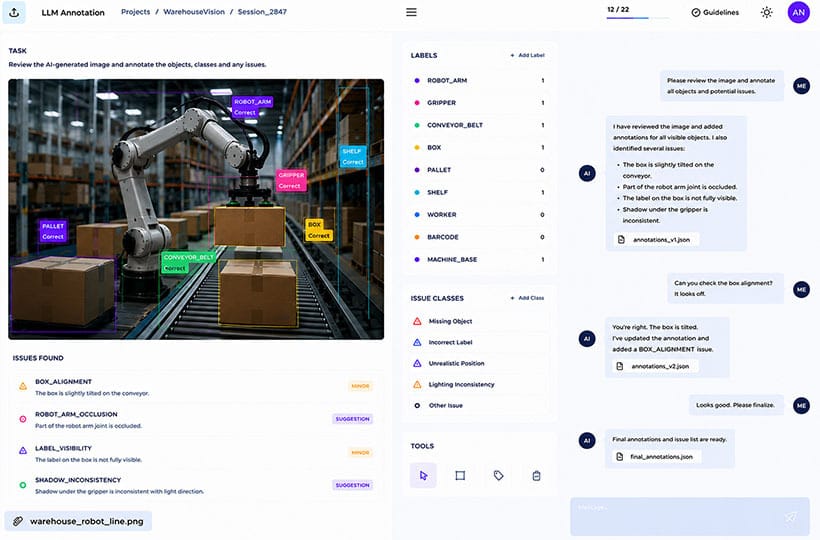
Agentic AI (agent systems based on large language models) represents a transition from passive text generation to active task execution in external environments.
A key element is the planning mechanism, where complex tasks are decomposed into subtasks that are executed sequentially or in parallel. This enables multi-step reasoning and structured workflow execution. When integrated with external tools (APIs, databases, code interpreters), models can go beyond text generation to perform real operations in digital environments.
“Reasoning and acting” cycles, in which the model alternates between reasoning and action-execution stages, gradually refine the task-solving strategy through interaction with the environment. An extension of this concept is multi-agent systems, where several specialized agents coordinate their actions to achieve a common goal.
Retrieval-Augmented Generation (RAG) Systems
Retrieval-Augmented Generation (RAG) is a hybrid paradigm that combines parametric knowledge stored in large language models with non-parametric external knowledge sources, such as vector databases, search engines, or structured knowledge bases. The main idea is to improve factual accuracy and reduce hallucinations by grounding model outputs in the retrieved context relevant to the input query.
In a typical RAG pipeline, an input query is first transformed into an embedding representation, which is then used to retrieve semantically similar documents from an external index. These documents are subsequently injected into the LLM's context window, allowing the model to generate responses conditioned on up-to-date, domain-specific information. This separation between retrieval and generation enables dynamic knowledge updates without retraining the underlying model.
A key architectural component of RAG systems is the embedding model, which encodes both queries and documents into a shared vector space. This is often paired with vector databases that support efficient nearest-neighbor search at scale. Advanced implementations also incorporate hybrid retrieval strategies, combining dense vector search with sparse lexical methods to improve precision.
Efficiency & Inference Optimization
FAQ
What are the main AI trends shaping the development of LLMs today?
AI trends today are driven by scaling efficiency, multimodal models, and agentic systems. There is also a strong focus on retrieval-augmented generation and safety improvements. Together, these trends define the direction of modern generative AI growth.
How is generative AI growth influencing LLM development?
Generative AI growth is pushing LLMs toward more practical, production-ready systems. Instead of only generating text, models are now integrated into tools, workflows, and enterprise systems. This expands their role from assistants to infrastructure components.
What is the role of Mixture of Experts (MoE) in modern LLMs?
MoE architectures allow only parts of a model to activate per request, improving efficiency. This enables much larger models without proportional compute costs. It is a key innovation for scaling LLM-based systems.
Why are agentic AI systems important for the future of LLMs?
Agentic AI enables LLMs to execute multi-step tasks rather than just respond to prompts. They can plan, use tools, and interact with environments autonomously. This shifts LLMs toward decision-making systems.
How does Retrieval-Augmented Generation (RAG) improve LLM performance?
RAG connects LLMs to external knowledge sources, such as vector databases. This reduces hallucinations and improves factual accuracy. It also allows models to stay up to date without retraining.
What optimization techniques improve LLM inference efficiency?
Techniques like quantization, distillation, and speculative decoding reduce compute cost and latency. KV caching and optimized attention mechanisms also improve performance. These methods are essential for the scalable growth of generative AI.
What challenges come with scaling LLMs?
Scaling LLMs introduces issues like high compute costs, data limitations, and training instability. As models grow, efficiency becomes more important than raw size. Balancing quality and cost is a core AI trend.
How is multimodality changing LLM capabilities?
Multimodal LLMs combine text, image, audio, and video understanding. This expands their use cases beyond language processing. It is a major step in the evolution of generative AI systems.
What role do safety and alignment play in LLM's future development?
Safety and alignment ensure models behave predictably and avoid harmful outputs. Techniques include policy constraints, filtering, and interpretability research. This is critical for real-world deployment.
What does the future of LLMs look like in general?
The future of LLMs is moving toward autonomous, efficient, and tool-integrated systems. They will act more like general-purpose agents rather than static models. This reflects the broader direction of AI trends and generative AI growth.